Where the Unseen Wait
I. The Festival in Ardel
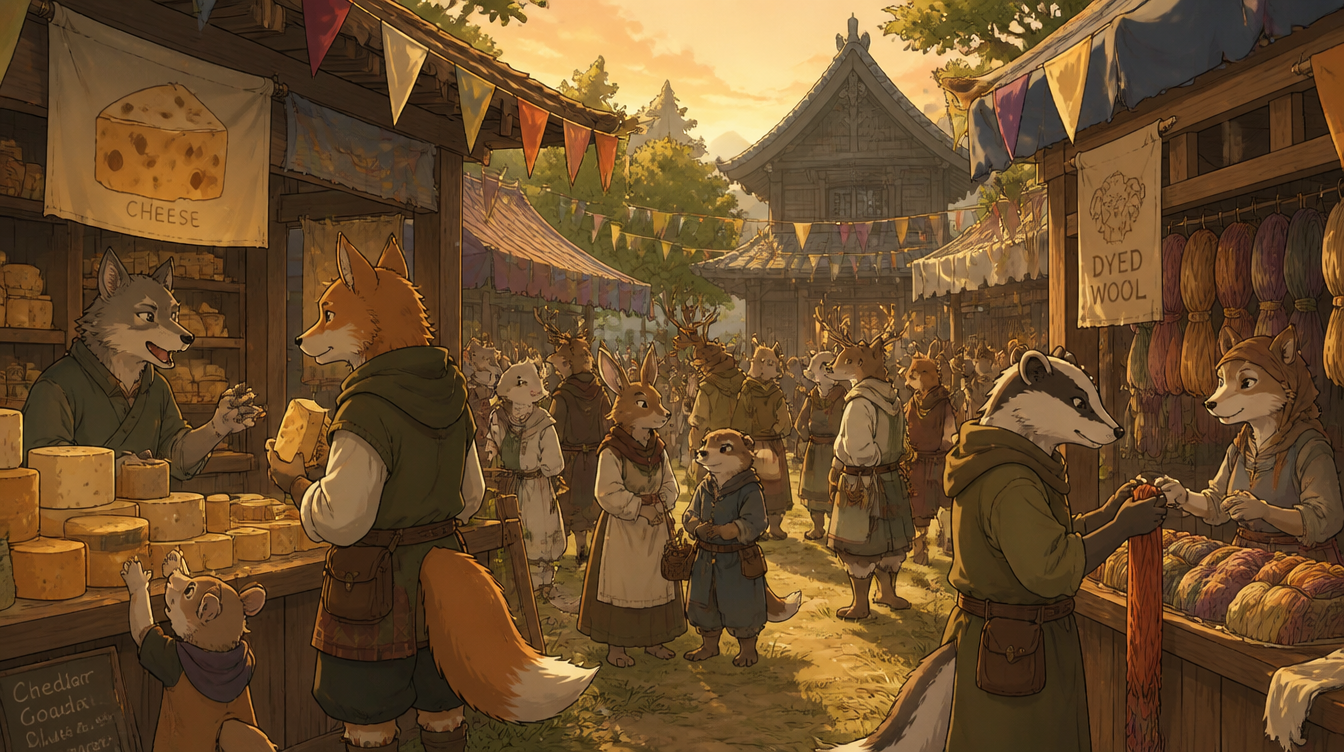
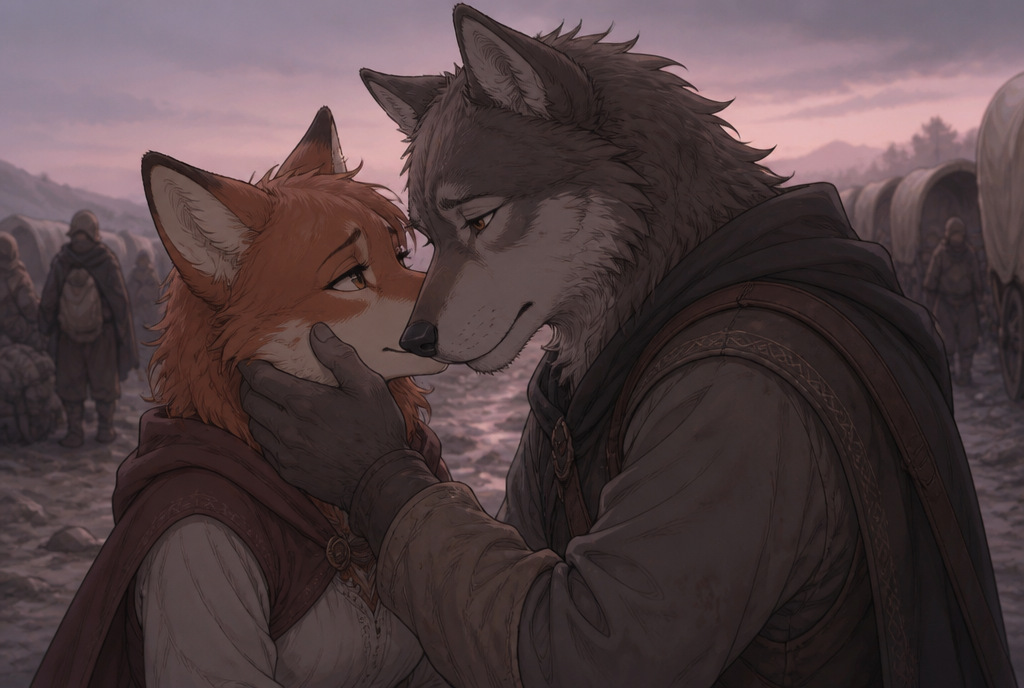
Lior had been drifting all afternoon, in the way he always drifted — paw in Tanen's, stepping where he stepped, eyes on whatever the next stall offered up to be looked at. His tail kept low, well-mannered, not even a switch. The festival was the same festival as last year, and the year before. The bunting along the temple eaves had been re-stitched; the otter boy who poured the cheap honey-wine had grown a thin moustache along the side of his muzzle; a ewe woman at the pie board had hitched her apron ties through the slit made for her tail and was scolding a pair of pups, one hare and one badger, for ducking under her arm; the lanes between the stalls smelled of fried dough and tar and old dust beaten up fresh.
Near the stone cross, folk still brushed knuckles or wrist to the worn corner as they went by. They did not stop for it. They barely looked. The hand went out and the body kept moving, making room for the next body in the same motion. It was the sort of thing Lior only noticed because it had happened last year too, and the year before that, as if the village would have felt lopsided without it.
"You alright?" Tanen said, not looking at him. The grey of his coat was darker around the shoulders where the day had warmed him.
"I'm alright."
"You've gone quiet."
"I'm always quiet."
"You're quieter."
Lior didn't have an answer for that, so he squeezed Tanen's paw instead, and Tanen laughed once — a small dry laugh that meant he had decided not to push. He pulled Lior toward the cheese stall. The badger cheesemonger gave Tanen the ordinary nod she gave everyone, which was, Lior had learned over years of Tanen's company, the highest praise she handed out. She pared a sliver from a waxy round without being asked and held it out on the flat of the knife. Tanen took it, bit off the rind end for himself, and put the better half into Lior's free paw as if the choice had been settled years ago, which it had. A smear of soft white clung to Lior's knuckle. Tanen wiped it away with his thumb while he dug for coins, quick as buttoning a cuff.
The iron militia-coin on the leather thong knotted at Lior's right wrist had one face hammered blank and a single notch on the other, where he had caught it on a well-rope two summers back during the call-up on the eastern marches. He worried it now with his thumb-claw, the way some people worry a pebble or a tooth. It was dull-black where it had touched skin. The notch was always cold.
"Ardel's shrunk," Tanen said.
"It hasn't shrunk."
"It feels smaller every year."
"Every village feels smaller every year. That's a thing about villages."
Tanen made a face like he was filing that one away to repeat to someone else. He was always filing things Lior said, which puzzled Lior — Lior felt he had said nothing memorable in his life. He tucked the wrapped cheese under his arm, checked without looking that Lior had actually eaten the sample, and bumped his shoulder lightly against Lior's when he found he had not yet. Lior ate it. Mild first, then a little sharp at the end. The sort Tanen always chose for him because Lior never chose in time.
They had known each other since boyhood. By now the habit of being looked after by Tanen sat easy on Lior: the older-brother shape of him, forever deciding where to stand, what to eat before the cheese went warm, when a day out would do Lior good whether Lior had thought of it or not. Two summers back, when the call-up came through Ardel and the eastern marches turned ugly, they had gone as boys who knew each other's habits and come back brothers-in-arms. Tanen had pulled Lior out of trouble there — Lior did not like to walk the particulars — and afterward it had seemed simpler to let Tanen keep deciding the small things as well. Lior had not chosen to come to the festival so much as failed to decline.
That was the shape of most of Lior's life. Things arranged themselves. The school had picked his trade for him. The trade had picked his hours for him. Tanen had picked the village to settle in, and the village had been Ardel because Ardel was where Tanen's mother was buried, and where folk knew better than to ask too closely about the sibling Tanen had not brought back from the eastern marches. Lior had said that sounds alright, and they had come. It had not felt like surrender. It had felt like taking the road someone else had already swept clear. Life with Tanen nearby was full of such cleared roads: a plate set by his elbow, wet boots turned to dry by the stove, Tanen's paw arriving at the small of his back in a crowd before Lior had even noticed the crowd had thickened.
Lior was, he thought, content. He did not test it often.
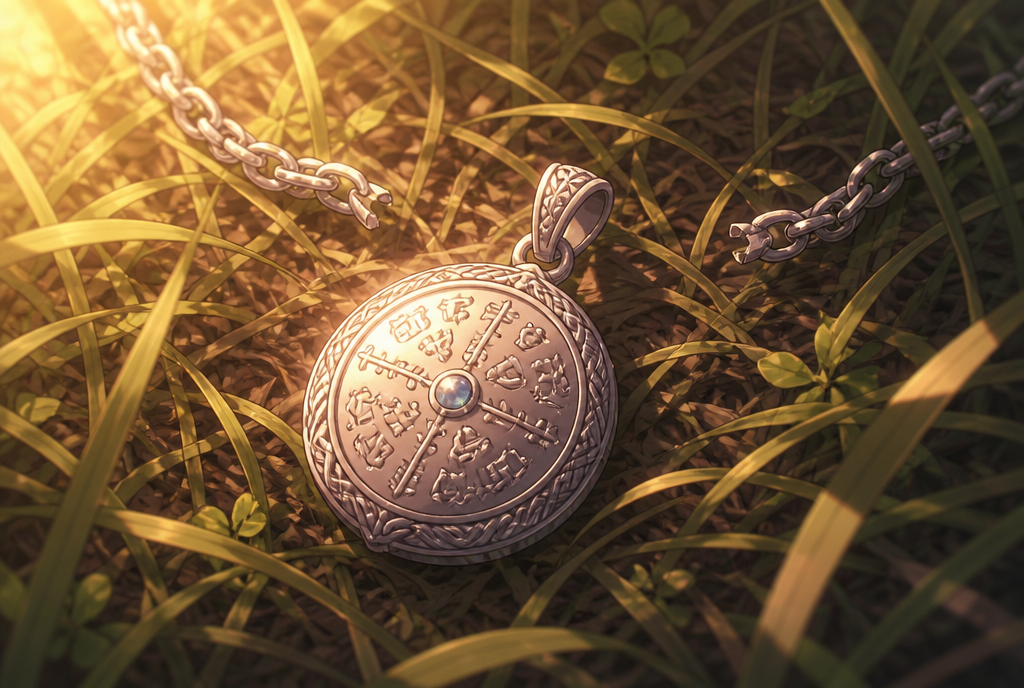
The drum-and-pipe player set up at the stone cross had begun something slow and wandering — the kind of tune that had no end built into it, only the player's lungs. People drifted that way in the shambling half-circle any crowd makes around music. A broad-hipped cow woman turned sideways to let a basket pass without clipping either of their tails. Someone lifted a crate of bottles clear of the narrow temple-side run folk kept leaving open between the stalls, the same way they kept the worn corner of the cross bare for passing knuckles. Tanen drifted that way. Lior, for no reason he could afterward name, drifted the other way: through that little open run, between the cheese stall and the seller of dyed wool, into a thin lane of trampled grass where the festival's noise softened by half.
The grass was bright. Late-afternoon light was pooling at the seam of the stalls, and something in the seam caught the light and held it. A strip of blue wool had snagged on a nail there and worried in the light.
Lior crouched. His russet brush of a tail dragged once through the cool grass behind him, and he barely noticed.
It was a pendant. Silver, or something silver-coloured. Smaller than his thumbnail. A loop of chain still attached but broken, the broken ends very clean — as if it had been cut, not snapped. It ought to have looked cheap at that size. It did not. It sat in the grass as if the grass had grown around it and failed to dull it. The metal held the light without softening it. Marks were cut into the silver. Not letters. Not any letters Lior knew.
He picked it up.
It weighed wrong. Too much for something so small. Village jewelry was always warm-edged under the thumb, a little blunted by years or by the hand that had made it. This had no give to it. The cuts were too fine. The links nearest the break were dark with age. The break itself shone.
The marks were small enough that to see them properly Lior had to bring the pendant close, and once it was close he did not put it down. He turned it. The marks turned with it. Each mark was its own small shape, none repeating, and there was a logic to the order of them — Lior felt that logic the way one feels a sentence's grammar before its words have been parsed. He turned the pendant the other way. The logic still held.
Behind him, somewhere, the drum-and-pipe kept on with the same wandering tune. Lior could still sort the sounds: pipe, drumskin, a child's sharp laugh, the badger woman's flat answering scold. Tanen called his name again. The sound found him. It ought to have meant more than it did.
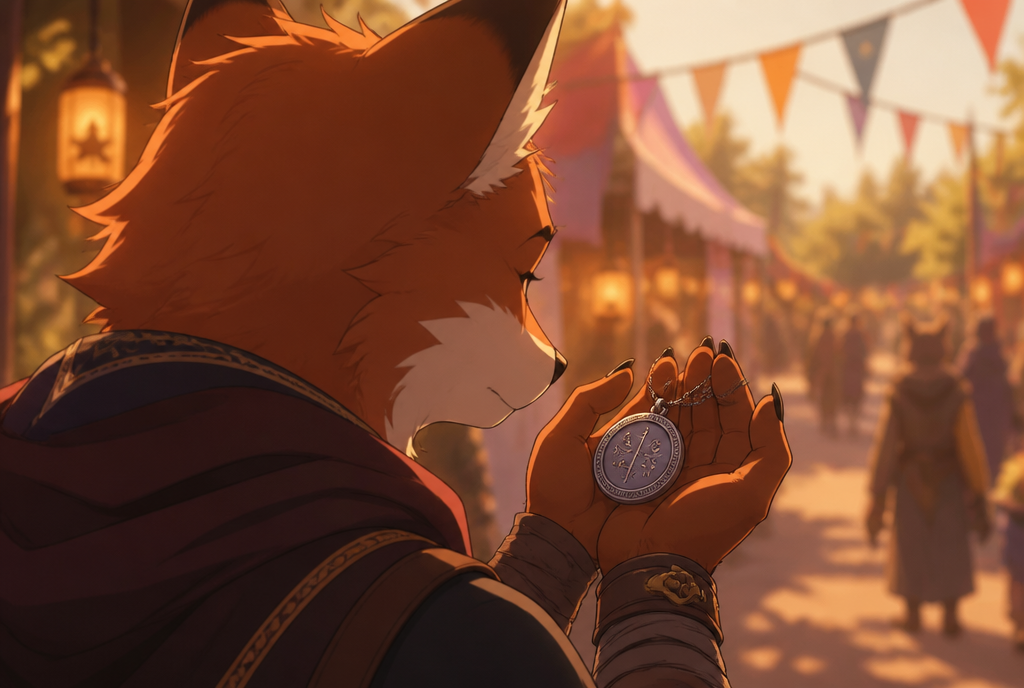
In front of him was the pendant, and the marks on the pendant, and the way the marks went on being marks no matter how long he looked at them. They looked like nothing Lior knew. They looked ordered all the same. Lior turned it a hair's breadth. The order held. A sentence, almost. A mouth shaping itself just before speech.
A child laughed again. Somebody hushed the child. The cheesemonger said something. Lior heard each voice come clear and thin, as if laid out on a board. Meaning loosened. Not gone. Just slipping. Tanen called his name a third time, and Lior knew it was his name only because he had known it a moment before.
He put his thumb on the notch in the coin and counted once under his breath. One. Two. The notch was cold. The counting did not help.
When he next thought to look up, the lane between the stalls had not changed. The light had not changed. The tune from the cross had not changed.
The lane was there. It was not a lane. The stalls were there. They were not stalls. The dyed wool hanging in its rack was red and blue and rough where the cut ends showed. That was all. A colour. A texture. Nothing that asked anything of him. He could not have said what village it was sold in. He could not have said what village he was in.
His hand was cold. The coin was cold. The hand did not feel borrowed exactly. It felt unclaimed. He looked at the notch in the iron and could not have said whose wrist it lay against.
The marks on the pendant turned again under his thumb.
Lior looked up the second time.
II. The Pillar
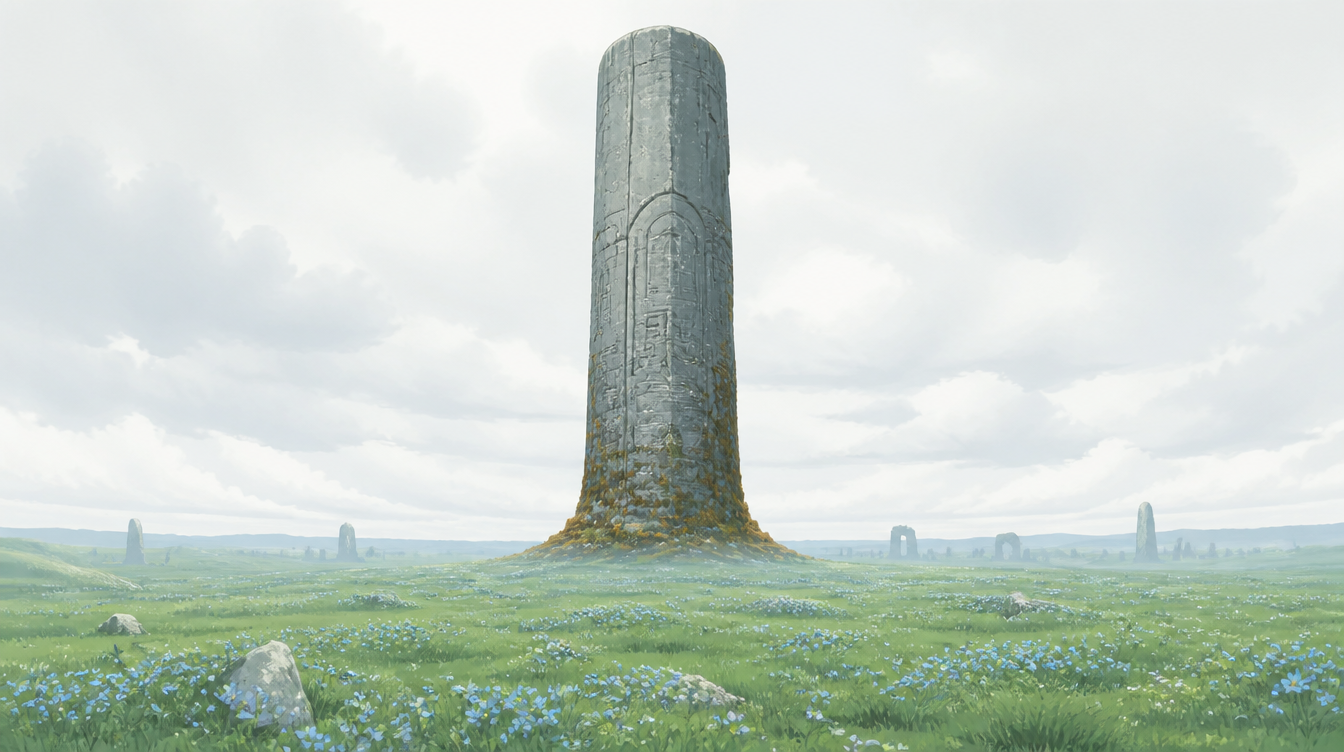
The plain was wide, and very quiet, and very green.
Lior had been standing on it for some time before he noticed he was standing on it. The festival had not so much vanished as released him — he had the impression of stepping off a moving cart at full pace, of the cart going on without him, wheel-song and laughter and torchsmoke all snatched away in the same instant, leaving only this brightness, which was not warm. The grass came to his knees and bent under him when he shifted, though the light laid no shadow down in it; he felt, absurdly, the press of his own weight in his calves, as if whatever part of him had been brought here was still heavy enough for the earth to know. Small blue flowers stood up among the grass at intervals, none of them closer than an arm's length to its neighbour, as if they had been planted by a careful hand a long time ago and then left to wait.
The sky was overcast, but bright. It cast no shadow on anything. When the wind moved over the plain it touched the fur at Lior's wrists and the inside of his ears, yet it brought no smell with it at all — not rain, not soil, not leaf-mould, not the far smoke of cooking fires; it was the shape of wind with nothing inside it.
In the middle of the plain stood a pillar.
It was very tall — taller than the cross at Ardel, taller than the granaries — and very thick. Moss the colour of old copper grew up the base of it, ringing it to about the height of Lior's shoulder. Above the moss the stone was grey and weathered and cut, and what was cut into it, Lior saw as he came closer, was the same kind of mark that was cut into the pendant in his hand. The plain seemed, the longer he looked, to lean toward it from four directions at once; once, when he lifted his head, he thought he saw on the farthest rim of brightness another upright dark against the sky, and then trusted himself less than before.
The pendant was warm now. It had been cool at the festival.
Lior approached the pillar because there was nothing else on the plain to approach. He counted his steps to it without meaning to — one and two, three and four — and stopped at fifty-eight, with the pillar still some way ahead. He had not realised it was that big. When he took six more steps the distance seemed to shorten too quickly, as if the grass had folded under him; after that the pillar drew back again and stood where it had stood before, solemn and impossible.
A muffled voice was saying something on the other side of the pillar.
The voice was not a person's voice exactly, and not quite an animal's. It sounded like prayer — Lior knew the cadence — but held inside something. As he moved around the base of the pillar, slowly, listening for it to be a person, the blue flowers nearest the stone tipped their faces the same way, and the grass there shivered though the wind had gone still. The sound seemed to strike the pillar and remain in it a moment too long, as though the stone were reluctant to give the words back. It went on being not-quite-a-person.
There was nobody behind the pillar. There was nobody in front of the pillar either, when Lior came back round.
Lior looked up.
A creature was draped along the top of the pillar.
It was very large. The part of it Lior could see — the long sleek length of it from the chest forward, the impossibly long neck, the head with its slow eyes — was longer than three carts laid end to end. The lower half of it was hidden by the pillar, behind it, below it; Lior could not have said where the body ended and the pillar began. The creature's coat was the same overcast colour as the sky, and cast no shadow on the grass.
The creature stopped praying when it saw him.
It went very still.
"You..." it said, and the voice was less muffled, now that Lior was watching its mouth move. "You see me?"
Lior took a step back. Then another. He had not understood, until the creature spoke, that he had been afraid.
"Why wouldn't I see you?" he said.
The creature smiled — Lior could not have described how a face that big smiled, only that it did — and laughed once, a wet, surprised laugh, like a person being told a small piece of unexpected good news.
"It has been very long," it said, "since one of you could. We are called Maerun here, little one. I had thought that name done with your kind."
The name sat in the air between them as if it had weight too.
Maerun came down from the pillar. Lior could not afterward say how — it had been on top of the stone, and then it was on the grass, and the lower half of it had still not come into view; the pillar concealed whatever the body was below the chest, even now. Maerun laid its forelegs out flat, in the way a dog will lay down to be unthreatening, and rested its chin on the grass between them, so that its eyes were at the height of Lior's eyes.
Its eyes were the same colour as the moss at the pillar's base.
"Events like this are very scarce," Maerun said. "Most of the silver left in your realm remembers no hand long enough, and most hands that do touch it feel only cold metal. It must be destiny, that one of you would come, on this day."
Lior did not know how to begin to disagree with it about destiny.
"Help?" he said, instead, because he had caught the word help somewhere in the wet laugh and the little one. "I don't even know where I am. I don't know what you are. I don't know how I came here. And why can I see you, if other people can't?"
Maerun's eyes narrowed slightly, in something that might have been fondness, or might have been nothing.
"Now... you are right," it said. "It is a poor kind of asking, to ask before answering. I will be brief — there is not much time to spare, here. In here, time goes faster than where you came from. That is one answer. The other is only that sometimes a door opens as if it remembers what it was made for."
It lifted one of its forefeet — Lior did not look at the foot directly — and pointed at him.
"First. You are not really standing here. You are what your people call a soul. The real you is still in your realm, at the festival, with your hand on the silver. The pendant made it possible."
"I'm not really here?" Lior said.
"A part of you," Maerun said. "The part we can speak to. The part that matters."
Lior looked down at the grass around his legs. It still bent where he stood; when he shifted, the blades lifted slowly, as though something sober and invisible had risen off him a moment late.
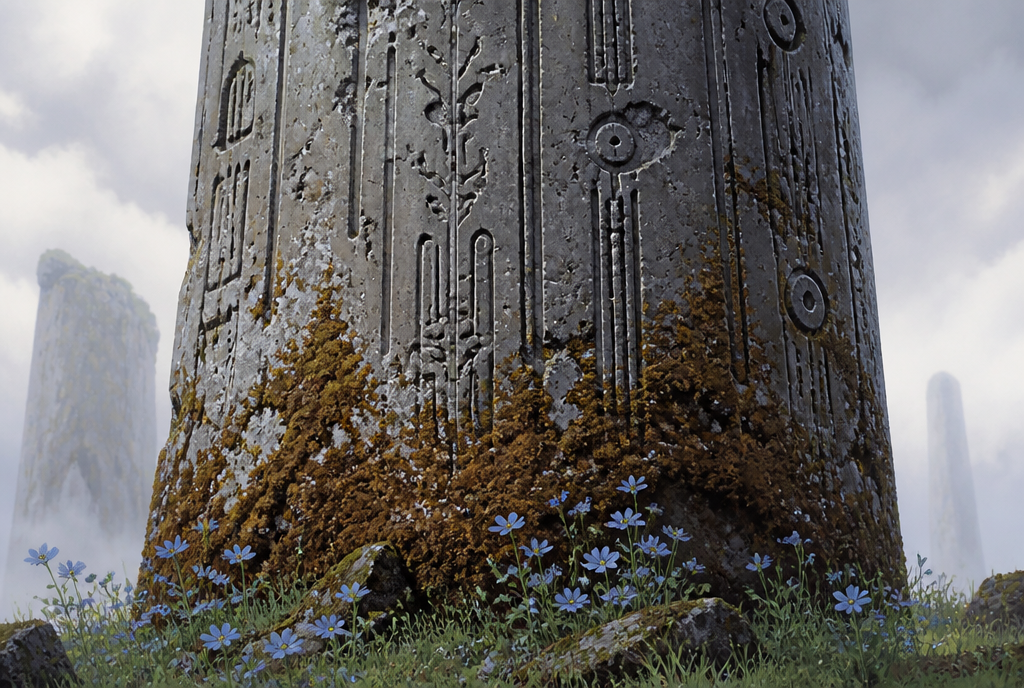
"Then why can I feel the ground?" he asked.
"Because this realm does not care for the neat names your people give things," Maerun said. "What crosses into the unseen arrives with the habit of weight still on it. Sometimes the world is kind enough to accept the habit."
"What happens if I take the pendant off?"
"Now... I would not recommend it," Maerun said, and something in the prayer-muffled voice roughened. "Not while you are here. You would be left stranded in this realm, and there are few enough crossings left already; I do not know when another silvermark would answer us. But fret not. I can send you back. I want to send you back. I am only going to ask you for something first."
Lior counted four breaths before answering, very quietly. One and two, three and four.
"Alright," he said, though it came out smaller than he meant it to.
"There is a being," Maerun said, "in a realm very like this one, who is slowly corrupting everything. It is not only her own realm she is corrupting. It is leaking out, through. You know what I am speaking of. Do you not."
Lior did not know.
Then he did.
"The fires," he said.
Maerun lowered its head by a fraction, as if that had cost Lior something to say. "Her influence," it said, "taints every living thing that meets it. They turn into the things you have seen them turn into. We call her the Veiled."
Lior had heard nothing in his life with a name like the Veiled. He had heard, in the last weeks before the festival — and somehow he remembered this only now, standing on the plain — about the fires.
"What is she?" he asked. Practical questions arrived easiest when there was too much else to hold. "And why would I be the one to go to her? If I'm only—" He made a helpless movement with the pendant hand. "—this."
Maerun was silent for long enough that Lior heard the grass moving under its own blades.
"Now..." it said at last. "She is a being who was bound, a very long time ago, because what she was could not be left loose in the worlds. I was there when it was done. We were. I will tell you the rest when the telling can do more good than harm."
That was not an answer, or not much of one. Lior opened his mouth anyway, and shut it when Maerun went on.
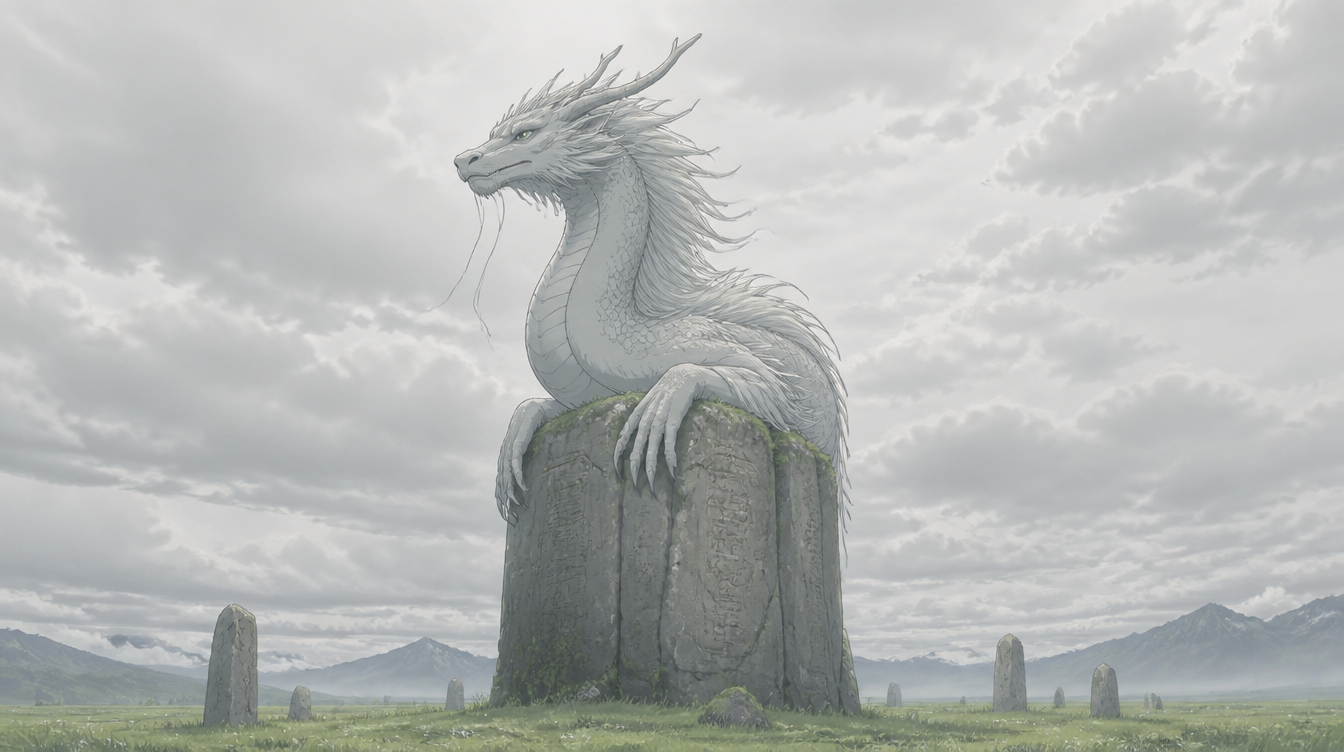
"There is a prison," Maerun said. "The binding has loosened. We need her bound again. To bind her, you would need to walk through the doors of her prison and put this around her neck. The silver brought you because you can see, and because seeing is not nothing, little one."
Maerun reached behind the pillar with the foot Lior had refused to look at.
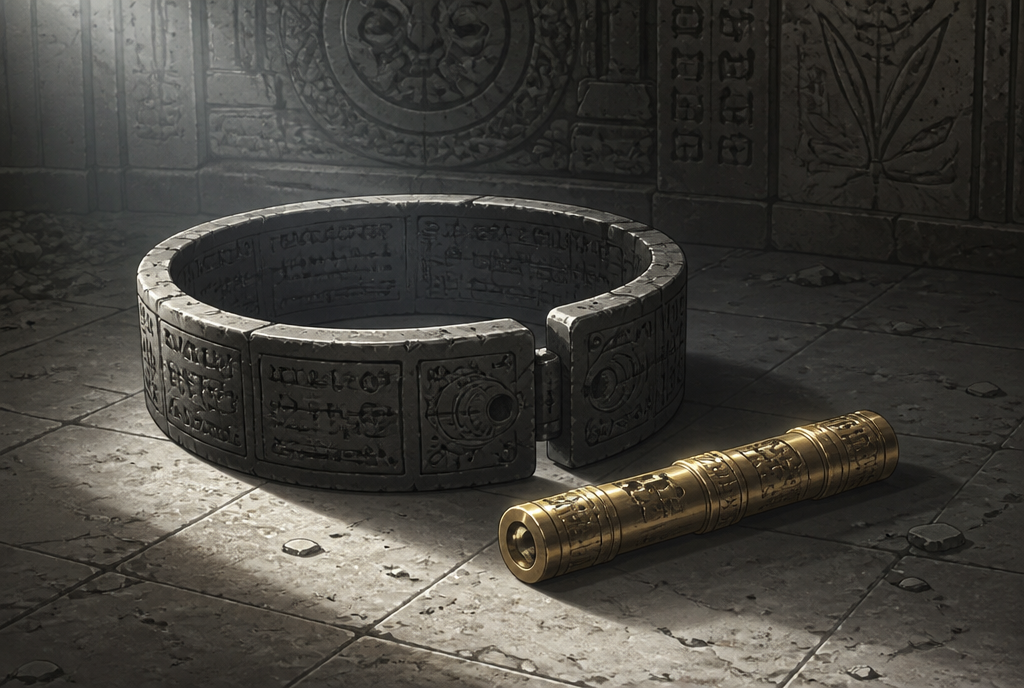
When it came back into view, the foot was carrying two things: a stone collar, the colour of the pillar, with the same marks cut into it; and a golden cylinder, smooth, the length of Lior's hand. The cylinder turned slowly, of its own weight or Maerun's grip — Lior could not tell which.
Maerun laid them down on the grass between them. The blue flowers nearest the collar bowed their heads, and the pendant in Lior's hand answered with a pulse of heat so sharp it was almost pain.
"That is all I have to do?" Lior said.
Maerun looked at him for a long time. The plain seemed to hold its breath with it.
"No," it said, with a gentleness that frightened Lior more than urgency had. "It is all I have asked in words. I will not push you to do something you do not wish to. That is why, before I send you to her, I will send you back. I want you to see what has changed, in your realm, since you held the silver. Then come back to me, here, and tell me what you have decided. Will you do that much?"
"And if I do not?" Lior asked.
Maerun's gaze did not leave him. "Then you do not," it said, after a pause so long it might have been honesty arriving by effort. "The silver will cool, in time. We will go on waiting as I have waited. I would grieve it; I would not drag you where you would not walk."
Lior looked down at the things on the grass. The collar was not large, not beside Maerun, but it was made for something bigger than any neck he knew. The marks cut into it ran under the skin of sight the way the marks on the pendant did, less like scratches than like a tongue trying to remember itself. The cylinder looked simpler; when he stooped to touch it, it rolled once into his palm as if it had been waiting for the shape of a hand. It was warm. The collar was colder than river stone in winter, and heavier than it should have been. For a moment, holding both, Lior had the deranging certainty that he was carrying not objects but decisions — that if he dropped them here the grass would remember, and if he kept them the heat of the silver would follow him home.
Home. Tanen at the festival, perhaps not yet noticing he had gone still; Ardel with its rooflines and the cross and the lane behind the granaries; the fires, suddenly no longer rumour but something with a mouth somewhere in another realm. See what has changed, Maerun had said, and the words made a practical horror of it. What if there was nothing left to see except what had survived them.
His fingers tightened around the cylinder. The pendant burned against his skin in answer. Lior swallowed.
"Alright," he said, and this time the word was not agreement exactly, but the shape of taking hold. "I'll go back. I'll look. And if I can come here again—"
"You can," Maerun said too quickly, then lowered its head, ashamed of the haste. "Now... we will make sure that you can, little one."
Maerun lowered its head fully, for a moment, until its forehead rested on the grass, as though in prayer or gratitude; Lior could not tell which, and perhaps there was no difference.
When Lior looked up the third time, the plain was gone.
III. The Road
Lior was walking.
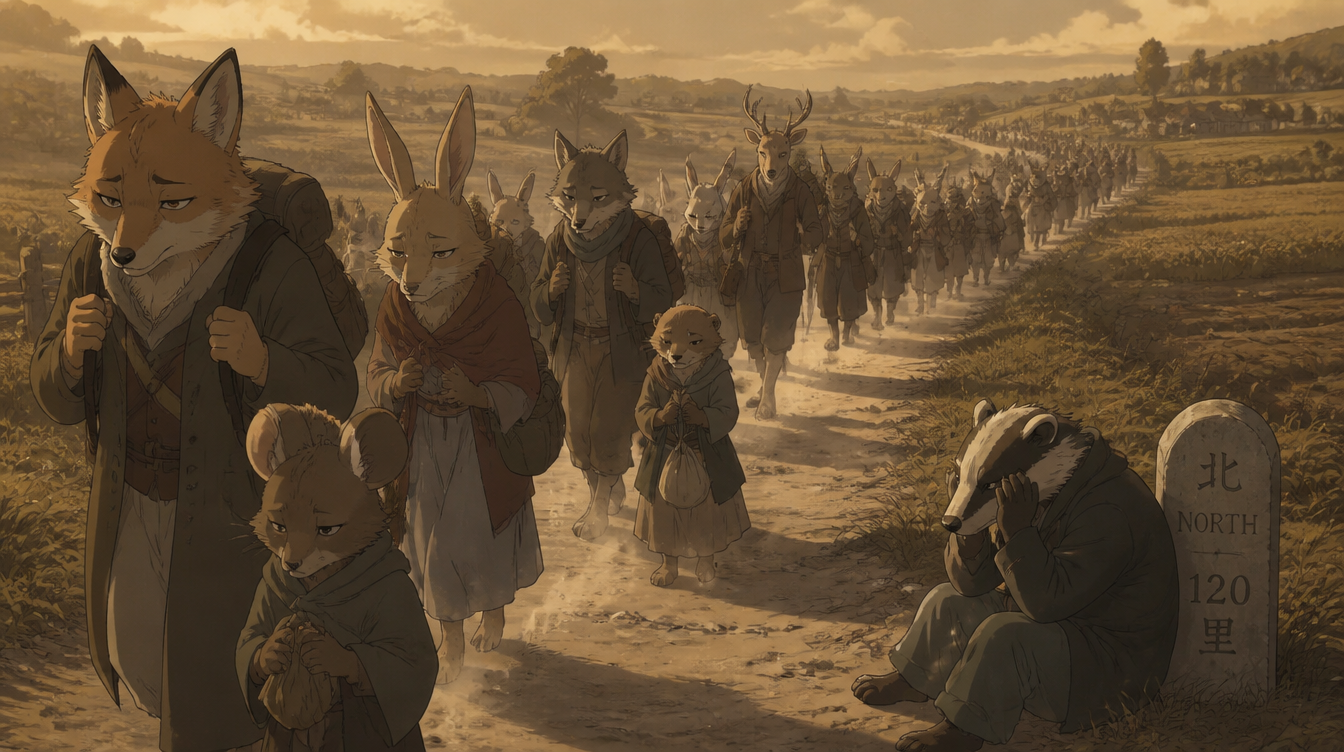
That was the first thing Lior noticed — the long swing of one footpaw in front of the other, dust rising in small puffs, the soreness in the small of his back that meant he had been walking for hours. His left heel had rubbed raw inside the shoe. His shoulders ached where the coat seam had gone stiff with old sweat. The second thing he noticed was that his paw was in Tanen's. The third thing he noticed was that he was on a road, and that the road was full of people, and that all the people were moving in the same direction.
Not fast. Not slow either. Road pace. The pace a column fell into when there were carts, children, bad straps, old knees, and water to save. A pace that said there was nowhere good to be by nightfall, only a less bad place if they kept going.
Otters and badgers and an old vole couple and a few hares — Lior knew them, all of them, from the markets and the festival, from borrowing salt, from standing behind them at the baker's, from seeing their faces often enough that the thought of them had once meant ordinary days. Now they were walking the same dust together. A goat carter with one horn wrapped in dirty cloth kept stopping to retie the rope that held the sideboard of his cart in place; each time the knot slipped he set it with his teeth and moved on before the wheels had stopped rocking. A young hare, coat gone pale with road dust, had a saw-handle through his belt and his boots hanging from one shoulder by their laces, saving the soles for later miles. Behind Lior, a mouse mother shared out a waterskin by count to two children too tired to quarrel: one swallow for you, one for you, cap back on. Somebody had tied a saucepan under a cart for want of room and it knocked against the axle at every rut. A blanket had been strung from one cart-rail to another so three washed shirts could dry while the owner walked. None of them looked surprised to still be doing any of it. The road had become something they knew how to do.
"Are you alright?" Tanen said.
His voice was very tired.
"Just a moment," Lior said.
"Come on. We can't linger."
Lior walked. His feet knew the rhythm of the column. His feet had known it for days. There were rules to the road. Keep left when a cart swayed. Pass water hand to hand with the cap already loose. Do not ask a child if they are tired because they are. Do not look back south for long. Lior knew all that with the ease of long practice and hated the knowing. The pendant was in the inside pocket of his coat; he could feel its small weight against his ribs; his hand, the one not in Tanen's, was already in the pocket without having gone there on purpose. One edge had been worn smoother than the rest. His thumb found that place at once, as if it had learned it before he had.
The column was not only people from Ardel.
Lior saw a hare-woman from the next village over, the one whose son had married a girl from Ardel last spring — the woman was carrying a kettle that had been hung over a fire for too many years; the soot on it came off on her sleeve. Lior saw an old badger sitting at the verge with his back to a milestone, not crying, not exactly, only holding his face with both paws. Lior saw a kit in a basket on the back of a donkey-hitched cart; the kit was asleep; the donkey's flanks were sore. Farther up the road, on the backboard of an ox-cart, somebody had painted a village-mark Lior did not know and then crossed it out in soot. Another cart carried feed sacks stamped with a mill-sign from somewhere south of Ardel. More people kept joining the line from side lanes and field tracks. Nobody greeted them. They just made room.
Somewhere ahead two men were arguing in low tired voices about whether Eshea was letting everybody in or only those who came before dark. Somebody else said that had been yesterday's rumour. Somebody answered that yesterday had still been yesterday. The column kept moving.
When the road narrowed at a washout, the whole line bent and thinned without anyone needing to be told. Carts took the middle. Walkers went to the grass. Somewhere ahead a sack of turnips split, and by the time the burst cloth came into view again the turnips were back inside it, passed hand to hand, the knot re-tied with a strip torn from somebody's hem. That, too, seemed to belong to the month Lior had lost: the way strangers had stopped being strangers once the road began.
It hit him then.
Not as discovery. As memory.
Fires in the dark.
Smoke under the door.
The shout from the south gate.
The gate-beam splitting.
The wall giving way in a noise too large for the village.
Not all at once. One piece. Then the next.
The cheesemonger's stall burning first.
His house after it.
Blue flame along the cheesecloth.
A bucket line failing before it reached the well.
Tanen saying we have to go now, too calm, with ash already on his sleeves.
His own hands dropping a plate and leaving it where it broke.
The cart half-packed before dawn.
The first three days on the road.
Wet wool.
Donkey sweat.
Lamp oil.
Fear.
Lior missed a step. Dust slipped under his foot. His stomach turned hard. Tanen's grip clamped hard on his paw. Lior felt the calluses on Tanen's pawpads, the carpenter's calluses, the same calluses that had hauled him out of the ditch on the eastern march two summers back. He tasted spit and smoke together and did not know which belonged to now.
A whole month.
A whole month had happened to him, and he was only now remembering it.
He had walked it. He had spoken in it. He had slept and woken and eaten crusts of bread and pissed by hedges and kept going. Somewhere inside him was the part that knew every day of it. That part had not brought the knowledge back whole.
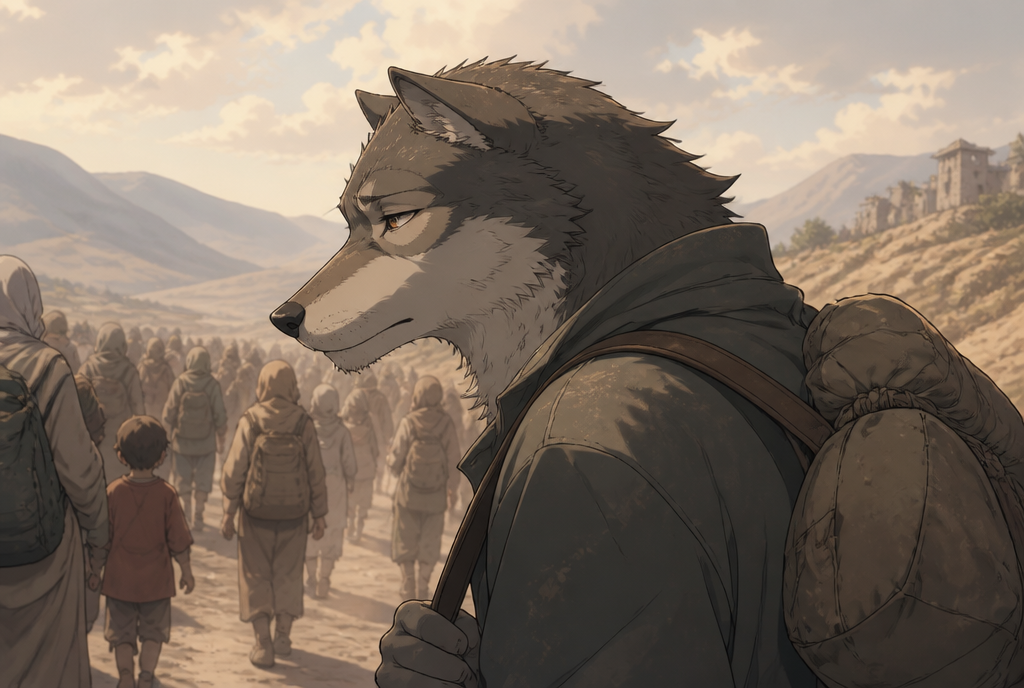
The paw holding his was Tanen's paw. The fur of his pawpads was rough at the seams, the way a carpenter's pawpads always were. The notch in Lior's iron coin was very cold against the inside of his wrist, the way it had been when he had crouched in the grass at the festival and picked it up.
"Tanen," he said.
"Yes, brother."
He only ever called him brother when he was worried. His throat closed for a moment.
"Can you remind me where we're moving to?"
Tanen looked at him, very briefly.
"What?"
"I'm sorry. Many things on my mind. Somehow it all just hit me. The attacks. The wall. When we left. All of it at once."
Tanen did not stop walking. He let several steps go past before he answered. He lowered his voice.
"A whole month trying to keep them out," he said. He tipped his muzzle toward the milestone they were passing, half sunk in the verge, its carved letters worn down to three shallow cuts under the dust. "And now we are going north. To Eshea. Five days if the carts behave. Six if they don't. The Siphia turn is at the split bridge, still ahead of us. Don't forget that or I'll really start to worry."
He laughed at that, a small dry laugh that did not reach anywhere. He squeezed his hand.
"The corrupted are moving east," he said. "If for some reason they come north — if — we take the west fork and run for Siphia."
"Siphia," Lior said.
"You used to know that. You knew it yesterday."
"I knew it yesterday."
"You knew it this morning."
"I know it now."
Tanen tried to smile at him, and the smile did not reach his eyes. His ears flattened a little against his skull when he did that — Lior had learned the gesture over four years and could not stop reading it. He let go of Lior's hand just long enough to catch a bundle sliding off the old vole couple's cart and shove it back into place with the heel of his paw. Then he took Lior's hand again. He had done that sort of thing all month, Lior thought. Catching what slipped. Tying what loosened. Making the next ten paces possible.
He walked. The column walked. The dust rose and settled and rose again. A child somewhere ahead began to cry with no strength in it and stopped just as quickly. Somebody called back for a wheel-pin. Somebody else said there was a stream half a mile on. The goat carter swore softly at his rope again. Every few paces Tanen's thumb moved once over the back of Lior's paw, as if counting them by touch.
Twice in the next stretch Tanen looked at Lior as if checking whether his face matched his step. Once he brushed dust from Lior's sleeve with two blunt claws and seemed not to notice he had done it. Once he passed him the waterskin, watched him drink, and drank only after. There was so much care in the little things that Lior wanted to say sorry and could not find a clean place to put it.
His coat still smelled faintly, impossibly, of sawdust and glue under the road dust. One cuff had been darned in a hurry with thread that did not match. Home had not gone all at once. It had gone by things pulled on anyway, by tools left where they had last been set down, by a man still wearing the work-coat he had fled in because there had been no sense in keeping a better one clean.
Lior thought his eyes are tired in a way I have not earned the right to look at, and could not have explained the thought even to himself. He had been beside Tanen for this month. He had spoken. He had eaten. He had slept and woken and kept going. Tanen had held the shape of those days for both of them. Lior had only arrived in the middle of them.
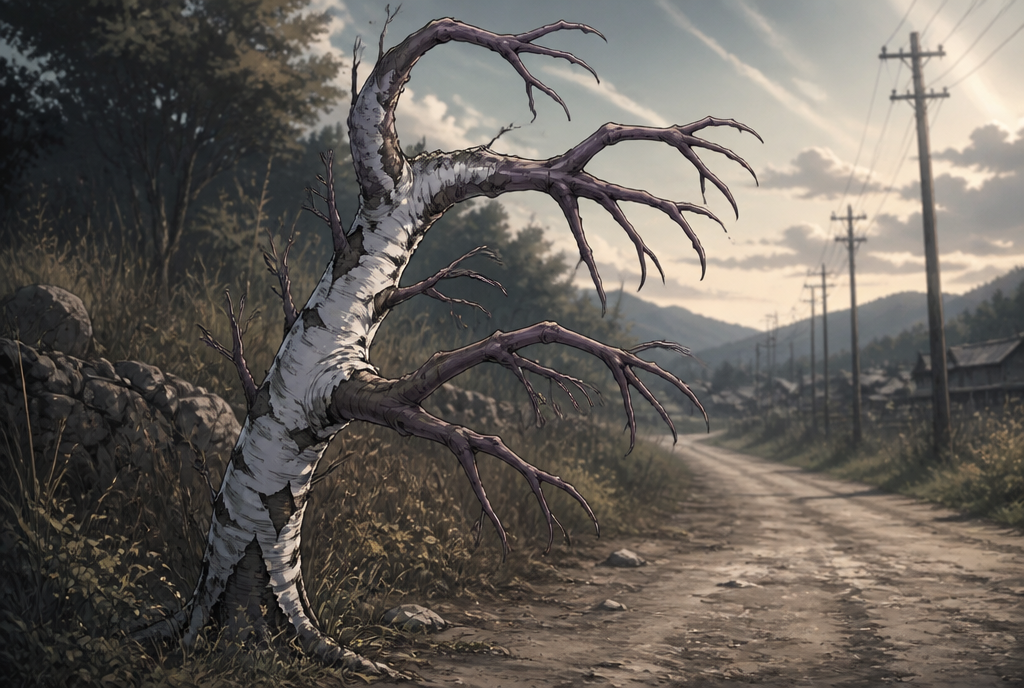
On the side of the road, against the verge, a young birch had grown wrong.
It was the first one Lior had seen up close. The bark was the bark of a birch — the white papery skin Lior had peeled as a child to write on. But the branches did not branch. They reached. Each end of a branch was a thin many-fingered thing the colour of a bruise. The leaves stirred in the small wind. The finger-ends did not. They only stayed reaching, as if waiting to take hold of whatever passed close enough.
Nobody on the road went near it. A doe carter clicked her tongue and edged her mule wide so the wheel missed the little patch of shade. A half-asleep badger kit lifted a paw toward the white bark because children still reached for what was bright, and his father knocked the paw down without breaking step. "Go wide," someone muttered, not loud enough to belong to anyone. The wind was on Lior's face. The branches did not move.
Lior thought about saying something to Tanen about the birch, and did not.
"Everything will be all right," Tanen said. He was looking at the road, not at the birch.
Lior opened his mouth. "Tanen, I—"
He looked over.
"There was..." Lior said, and stopped. The next word would not come. A man. A thing. A voice. None of them were right, and all of them were too much.
"What is it?" Tanen asked.
Lior felt the pendant under his thumb inside the pocket.
"If there was a way," he said. "If it was in my hand. To stop it. To stop all of it. I should do that. Shouldn't I."
Tanen laughed properly this time. He even tilted his head back.
"Of course," he said. "And while you're stopping it, you can build Ardel back for us. With an extra privy this time."
He squeezed his hand again.
"Brother," he said. "We've been through a lot. Let's focus on getting safely to Eshea first. Alright?"
He thought Lior meant grief. Helplessness. The common kind. If Lior told him now, he would only have one more fear to carry between one milestone and the next. Lior let him keep this one simple.
"Alright," Lior said.
He counted his next four breaths under his breath — one and two, three and four — and then his paw in his pocket closed hard around the pendant. The smooth place beneath his thumb was warm now. Or it remembered warmth. The road slipped sideways out from under his feet.
IV. The Temple
The first thing Lior was sure of was the smell.
It was the smell of a room that had not been opened in a long time — dry, slightly sweet, almost dusty but not, as if dust itself had once lain here and then been taken away, leaving only the memory of it in the air. The second thing he was sure of was that he was not on the plain. The third thing was that he was no longer holding Tanen's hand. The absence of his hand was so immediate he closed his fingers once on nothing.
He was standing in a doorway.
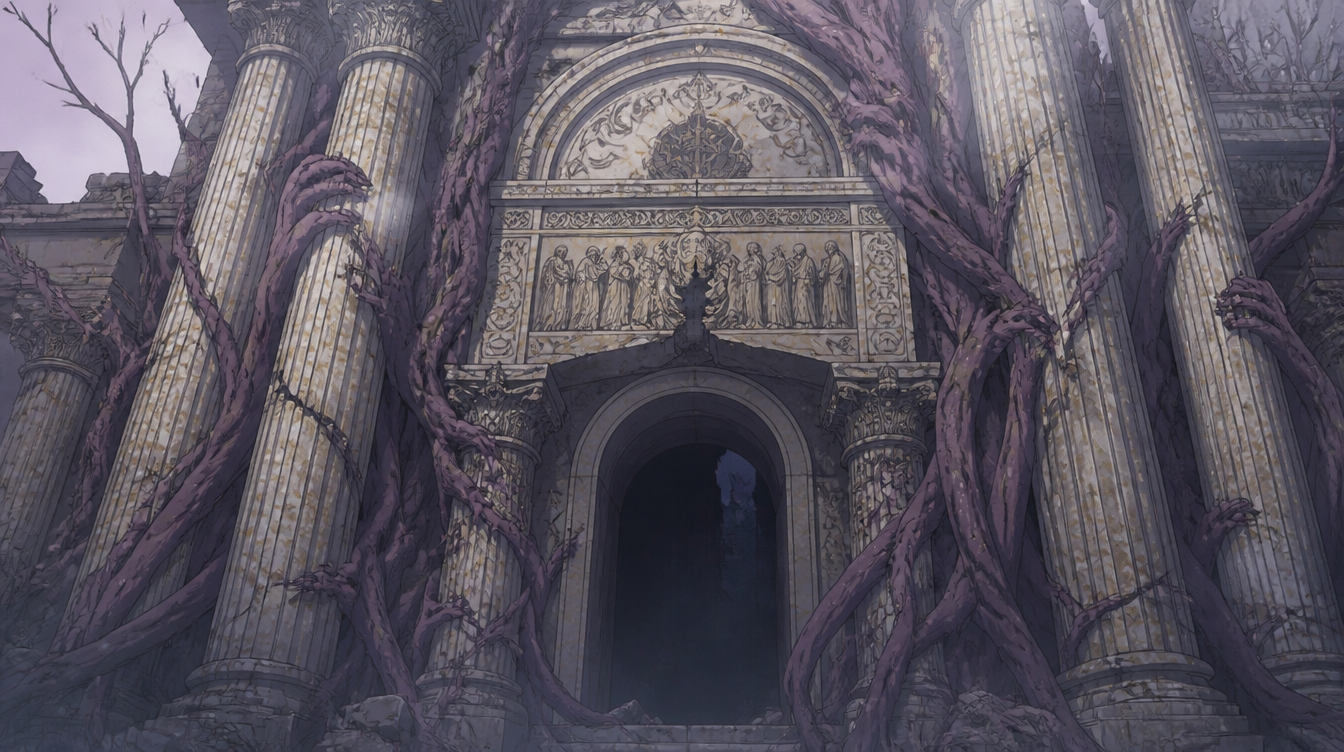
The doorway was not his. It was tall — twice his own height, and then twice that again — and cut from stone the colour of old bone shot through with thin veins of gold, so that even under the drift of settled grey it seemed to have light trapped inside it somewhere, patient and unwilling to go out. Its lintel was carved, and the carving had been beautiful once, and was still beautiful in the patient way ruins are beautiful: long robed figures holding bowls, rods, something like keys, something like collars, processing toward a centre chipped so thoroughly that the emptiness had become part of the design. They came in four processions, one to each side of the missing middle; what Lior had first taken for border-work was writing, marks too deliberate to be ornament, too ordered not to mean.
Above the lintel rose a façade of columns and blind arches, all of the same pale gold-veined stone, and all of them dusted, dust-grey, dust-grey, dust-grey. Dust filled the flutes of the columns and blurred the join-lines where blocks met, settling in the carved mouths and robe-folds until every figure seemed made to keep its own silence.
The columns had been beautiful.
Around the façade, growing up from the cracks in the temple's foundation, were trees.
The trees were dead.
The dead trees were the worst thing Lior had seen. They were the same kind of wrong as the birch on the road, except finished — what the birch had been becoming, these had become and stopped. Their trunks leaned at impossible angles, stripped pale in places and black in others, and their roots had grown up the columns and the walls instead of down. The roots were thick and many-fingered and the colour of an old bruise; they wound the temple like cloth around a wound, and where they crossed they had bitten into the stone so hard that the gold veining showed raw through the breaks.
Nothing moved. Even the dust seemed to have settled so completely into itself that movement here would be an offence.
"You took longer than I did," said a voice behind Lior.
Lior turned.
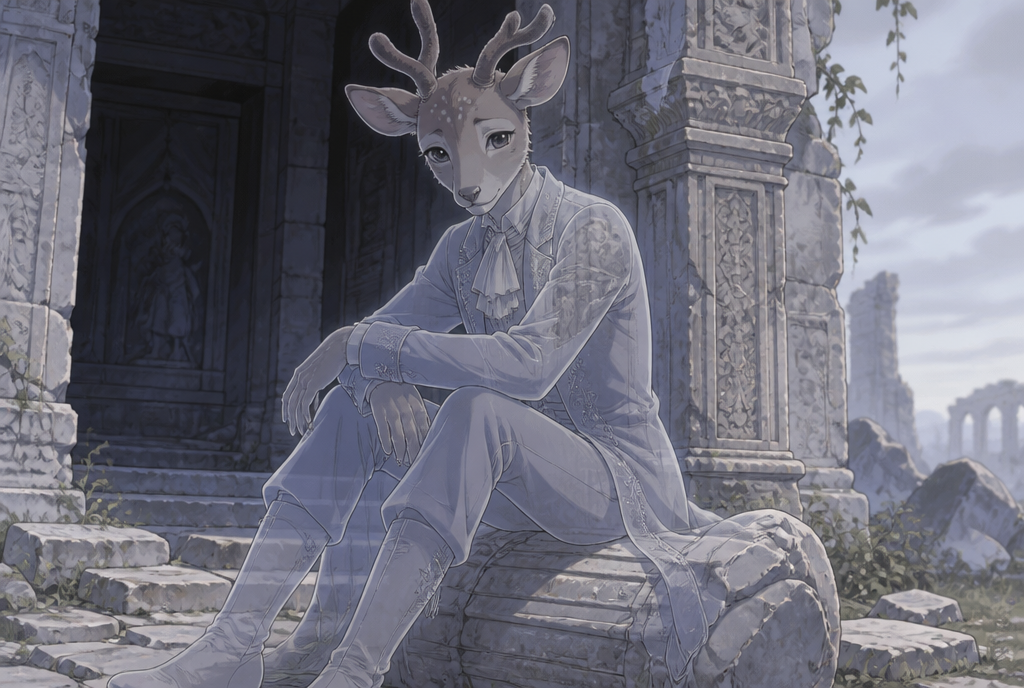
The voice belonged to a young deer — younger than Lior, maybe a few years younger than Tanen — sitting on a piece of broken column at the side of the doorway, with his arms crossed loosely on his knees. His coat was the colour of a fawn's first spring; his small antlers were still in velvet at the tips, and where the grey light caught that velvet it held there, dim and soft. His clothes were a kind of clothes Lior had never seen on any kind of person; the cut was wrong, the dye was wrong, the cloth was finer than anything in Ardel, and it had been made with quiet intelligence for tail and hock and antlers in a fashion no one wore now. He was not quite solid. Lior could see the broken column through his shoulder when he turned his head, and the dust that lay on everything else had not settled on him at all. His voice seemed to arrive a fraction before his mouth had finished shaping it.
"Hello," Lior said.
"Hello," Sevren said. "You have it as well, then."
"Have what."
"The silver. The silvermark, if you like the older word."
Lior put his paw into his pocket. The pendant was there; its little edge pressed cool against the pads of his fingers, and the glyphs on it seemed, absurdly, to sit up at being named.
"My name is Sevren," he said, and inclined his antlers a little, the way an older kind would; it was less a nod than a bow cut down to something the ruined place could bear. "I have been on this side for a long time. I am not going back. I want you to understand both of those things before I tell you anything else."
"Alright," Lior said. He had not yet said his own name. He was not sure why. Perhaps because the temple felt as though it listened when names were spoken, and he was suddenly unwilling to give it anything for free.
"He told you about her," Sevren said.
"Yes."
A little dust slid somewhere high above him; Lior looked up, quick and uselessly, and saw only one of the dead roots pressed into the arch like a hand through cloth.
"Did he tell you what he was, before."
"No."
"He didn't tell me either," Sevren said. His mouth made the small shape of a rueful almost-smile and lost it again. "Until I asked. And he wouldn't tell me until I asked, twice. So I'll tell you what I know, and then you can do with it what you like, because that is the rule of this place — anything you are told, you can do with what you like."
He looked at Lior steadily. There was no malice in him; no triumph in being the one who knew something Maerun had withheld. His fairness sat in him like another kind of patience.
"He had a sister," Sevren said. When he said it he glanced, just once, past Lior and into the doorway, as if the stone inside had heard the sentence many times already. "He and the Veiled were not always what they are now. They were of a kind. When she was put in this place, the binding cost his sister."
"His sister."
"Yes."
"Cost her how."
"You will have to ask him that," Sevren said. "I asked. He didn't answer. I think he doesn't have an answer. I think he has only the one outcome — that the binding worked, and his sister did not come back from it. He has prayed at the pillar a long time."
Lior's paw was very cold in his pocket. His thumb found the notch in the iron coin at his wrist, once, twice. A sister. A collar. A prayer going on for centuries. Under all of it: it worked.
"Why are you telling me this," he said.
"Because the binding will work this time too," Sevren said. He shifted on the broken column, and for an instant his weight seemed almost to matter; a grain of stone clicked away under his heel, though Lior could still see the edge of the column through him. "That is not in question. The collar will fit. The key will turn. The Veiled will be silent when you are done. He has not lied to you about that."
"But."
"But she will tell you a different story than the one he told you, when you go in there. And both stories will be true. And what you do with the two true stories is what you do." Sevren shrugged with the part of him that was not quite solid; the motion passed a little through itself, like smoke remembering a shape. "I am only saying — listen to her. He didn't lie. But he picked which truths to tell."
Both stories true.
Lior let the words sit in him. Not truth and lie. Two truths, and him in the middle. He counted without meaning to — one column, two, three, four — and hated that there were four of them.
"Why didn't you do it," Lior said. "You had the silver. Why didn't you."
Sevren smiled. It was not a happy smile, but it was a kind one; it made him look, suddenly and painfully, exactly as young as he must once have been.
"I did," he said. "I went in. I came out without using the collar. I gave the key back to him at the pillar. He sent me home. I didn't go home. I came back here, and I let the silver cool, and I sat down on this piece of column." He laid one translucent hand, almost absently, against the stone under him. "The fires in my own realm went on a long time after that. I do not know if they have stopped now. They had not stopped when I last looked, and I have stopped looking."
Lior did not know what answer he had wanted. Something that would make the shape of choice simpler than this. Sevren had denied him that too, gently.
He nodded toward the doorway. Even that movement was old with repetition.
"She knows your name," he said. "I do not know how. She knew mine."
"Lior," Lior said.
"Lior."
The temple did not answer, but it listened. The dead trees did not move when he said it. The roots did not loosen. Nothing did anything. The temple was a temple, and the doorway was a doorway, and Sevren was sitting on the column with his arms on his knees; and yet the name seemed to have gone somewhere, taken into the gold-veined stone the way water goes into dry ground.
"Go in," he said, with the same patience he had used for everything. "Go in, and listen, and decide. That is what is asked of you. Nothing more."
Lior put the pendant back into his pocket. For one breath he did not move. Then he looked down and found the collar already along his forearm — pale as pillar-stone, cut with the same stern glyphs as the silvermark, too old in its make to feel like anyone's personal tool. He had not seen the creature give it back to him. He had not felt the moment of taking it. The cylinder-key, smooth and gold and the length of his hand, was already in his fist as well, as if the crossing itself had remembered what belonged to the taker's keeping and returned it without asking.
He stared, then touched the collar with his other paw, half expecting it to dissolve. It did not. The stone was cool and faintly rough where the glyphs had been cut; the key sat smooth and warm in his fist.
"Alright," Lior said, though no one had asked him anything.
Sevren did not answer. When Lior glanced back, he was still on the broken column, watching with the kind of grave courtesy one offers someone walking toward a door that cannot be walked toward for him.
Lior went under the lintel.
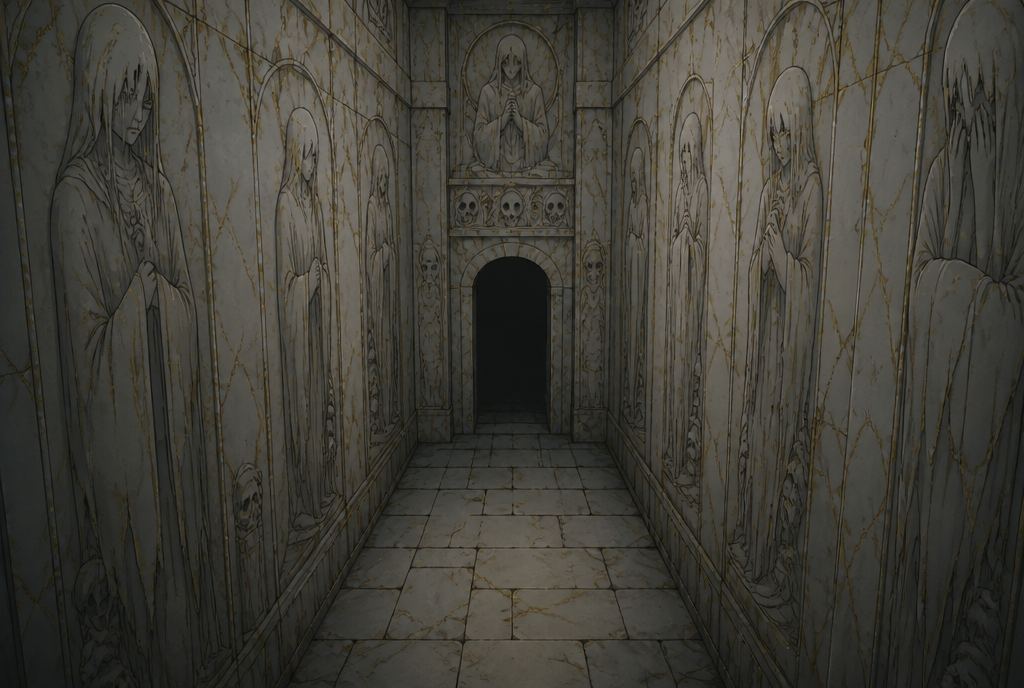
The corridor inside was short, but the shortness did not make it small. The air changed at once; not colder, not warmer, only more still, as if even the little breath the outside had been shut out behind him. The smell thickened. Shut-room sweetness; dust; stone. His footfalls did not echo properly. Sometimes the sound came back at once. Sometimes it came back three steps later, faint and misplaced.
There were no chambers full of riddles or of monsters. There was only the corridor, lit by some grey light that came from no direction.
Under that light the gold in the stone showed through the dust like old bruising beneath skin. The walls stood close enough that Lior could have touched both if he had stretched out his arms, and were cut everywhere with the same script as the silvermark and the collar, though here the marks ran longer, turned corners, climbed from floor to arch and back again, so that they felt less like decoration than a sentence too large for one pair of eyes to hold. Between the bands of script were worn figures, repeated in groups of four and divided by narrow emblems Lior could not parse — a line crossed by another line, a small square, a split circle, a pillar perhaps, or four of them arranged around something missing.
Dust lay thicker toward the middle of the floor, except where an old path had been worn shallow through it. The hollow ran straight down the corridor to the second doorway. Something had passed here often enough, once, to teach stone the shape of passage. Even so, Lior set his feet in it, one after the other.
Behind him came no sound from Sevren and no sound from Maerun, and that absence had pressure. It made the little noises louder: the soft drag of his sleeve against the collar, the nearly inaudible click of the key turning in his tightening grip, the whisper his own breath made under his muzzle. Listen, Sevren had said. As if listening were not the least armed a person could be.
He counted because his thoughts would not stay in order otherwise. One step. Two. Three. One breath, then another. Four carved clusters before the second doorway. Four. Always four.
At the end of the corridor was another doorway, smaller than the first.
Lior stopped just before it.
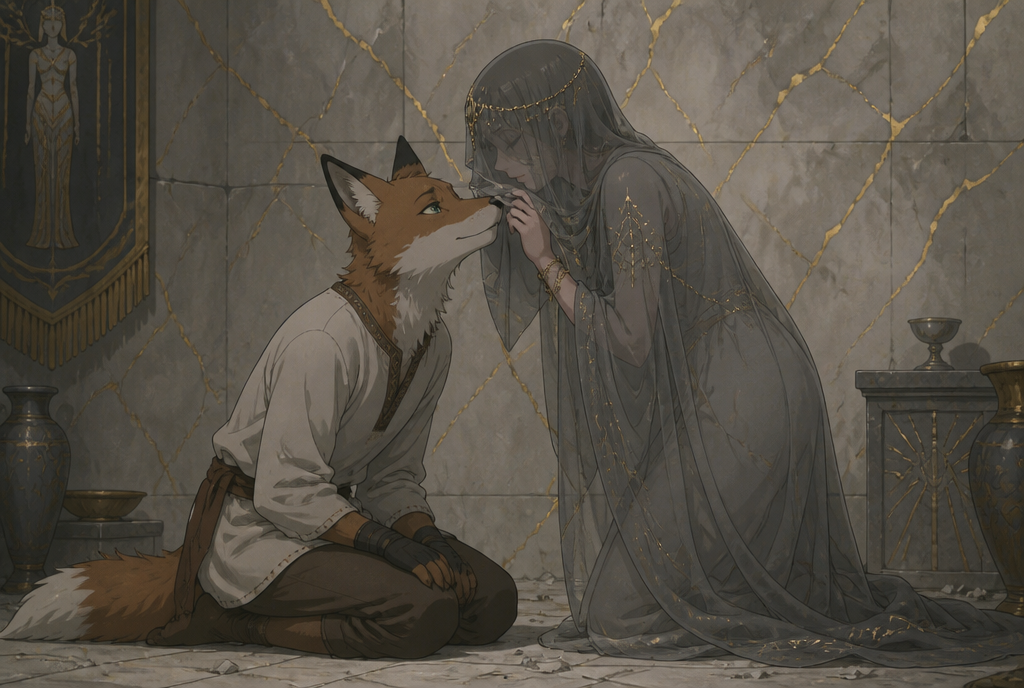
Through the second doorway he could see a small chamber — so small that the sight of it after the burden of the temple's face and corridor was almost a shock. The same gold-veined stone closed it in. Dust softened the corners. The carvings continued there too, more finely, crowding the walls in close patient ranks. Against the far wall sat a small veiled figure, no larger than a kit and not a kit at all, with her back to the stone. Her veil was a thin grey cloth that fell from the crown of her head to the floor and pooled there, and it moved a little when she breathed.
Lior stood with one paw on the worn hollow of the corridor floor and one still in the ordinary dust; the collar lay heavy along his forearm, the cylinder-key pressed into his fist, and all the temple's patient silence narrowed to the faint movement of that veil.
V. The Veiled
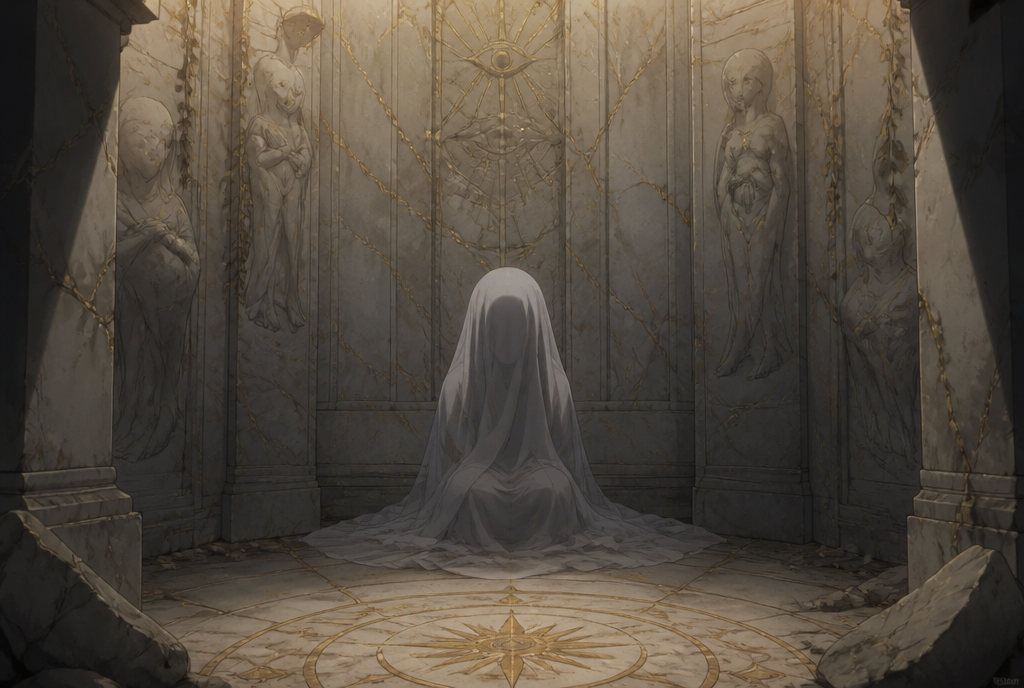
Lior stepped over the inner threshold, and the chamber gathered around him at once.
It was small. Lior had been in pantries larger than it, had stooped in winter cupboards with more air. The walls were the same gold-veined stone as the façade outside, but here they stood so close that the pale veins caught the grey light and held it, thread by thread; the room seemed stitched shut. The floor just inside the threshold was worn smoother than the rest, in a long pale oval, as if more than one person had stood there and failed to go farther for a very long time.
Dust lay in the corners, not thick, only patient. Every wall had been carved. Not figures only, though there were figures — long bodies kneeling, long hands raised, shapes bent under collars or wreaths or chains Lior could not have named. Between them ran the same cut marks as on the silver and on the collar over Lior's arm, except these did not look like ornament here. They ran in lines. They broke and began again. They climbed the corners and crossed the stone in bands that looked less like pictures than like sentences. Lior could not read a word of them. He was fiercely glad of that. It felt too much like standing inside the middle of something already decided.
She sat against the far wall. She was small — no larger than a kit, except that nothing about the way she sat was a kit's. Her veil was a thin grey cloth that fell from the top of her head to the floor, pooled around her, and moved a little with her breath; with each breath the cloth stirred the dust near it without quite touching. Lior could see the shape of her hands under the cloth — paws, perhaps; perhaps not; she was older than kinds, Sevren had implied. He could not see her face. He had the queer sense that she could see not only him but the wall beside him, the collar, the key, the whole room and the writing in it at once, as if she were sitting among familiar words.
"I have been waiting for you, Lior," she said.
"He sent me," Lior said.
"I know. We can hear him pray. We have always been able to hear him pray."
Behind him the corridor held itself still. Lior heard no step, only the kind of silence made by something very large staying where it was.
She used we the way Lior had heard old people use it about their own pain. Lior did not know what it meant from her.
"I have a collar for you," Lior said. The collar was over his forearm. The cylinder-key was in his hand. The stone knocked lightly against his wrist when he shifted, and the glyphs cut into it caught at his eye; up close they looked less like marks than like instruction, or a name, or a warning worn too old to need ink. He was not quite sure why he had said it like that — I have a collar for you — instead of any other way he could have said it. Perhaps because the Veiled had said I have been waiting for you, and the symmetry had felt right.
"I know," the Veiled said.
Her covered head inclined by the smallest degree, toward the collar rather than toward Lior, as if she had glanced across writing she already knew. There was no anger in her voice.
"Did he tell you," she said, "what I had done."
"He said you were corrupting your realm."
"Now."
"Now."
"And before."
Lior thought about it. The chamber seemed smaller for the question. One of the carved lines ran behind the Veiled's shoulder and around the room at Lior's eye level, disappearing behind his own back; it looked so nearly like a repeated phrase that he had to drag his gaze off it to answer. "He said you had been put here before. A long time ago. He said the binding had loosened."
"What had I done, before."
Lior was silent. The key sat in his palm with its own clean weight. He thought of Sevren on the broken column outside, saying both stories would be true. He thought of Maerun not telling, which was not the same as not knowing.
"He did not say," the Veiled said. "He did not say because there is nothing to say. I had not done anything, before. I was put here for what I was, not for what I had done. I was put here because of what I might do. The binding was the first injury I had ever taken from anything, and I was many years old when I took it, and I had not raised a hand to anything in those years, and after the binding I was not the same. The binding made me what he is afraid of. The binding made me what I now am."
She tilted her head a little. The veil's edge lifted and fell again.
"Is that not how all such bindings work," she said. "Isn't it so."
Lior did not know. He knew only that the wall-writing seemed to press nearer while she spoke, and that if it held the story of what had been done here, it held it in a tongue that belonged to her better than to him.
"He had a sister," he said. "Sevren told me."
"He had a sister."
"What happened to her."
"She was the binding," the Veiled said. "She put herself between the collar and me, when he closed it. She thought I was being wronged. She was not wrong. The collar took her with me. She is not in this room. I do not know where she is. He prays at the pillar, I think, in case she can hear him from wherever the binding sent her. I have never had the heart to tell him she is not there. We do not know where she is."
The veil moved with her breath. Behind Lior, from the corridor, came the slightest stone-sound — not a footstep, exactly, but the close-held answer of old stone to weight. Then stillness again. Maerun had heard that too, Lior thought; or perhaps he had made it.
"He is in the corridor," she said. "Behind you. He will not come closer than that. He has not come into this room in a long time."
Lior did not turn. The chamber was too small for turning without making it an answer. If he looked back, he thought, he would see only the doorway and the short grey length of corridor beyond it, empty to the eye and full to every other sense. The room would still know he was there. The carvings around the doorway were cut more thickly than elsewhere, the lines crowding close together like stitches at the lip of a wound.
"You have three things you may do," the Veiled said. "I will say them so we are both certain.
She did not raise her voice. She did not need to. There was nowhere in the chamber for sound to go without staying with them.
"You may put the collar on me. I will not stop you. The corruption in your realm will end the same hour. I will go silent. We will not bother anyone again. That is one.
The collar on Lior's arm seemed to answer the words by weight alone. For one blink the cut marks on its inner curve matched a line in the wall behind the Veiled so neatly that Lior had the ugly thought the room was only waiting for a body to finish reading itself.
"You may make a different binding with me. You and I. Spoken between us, in this room, with him as witness. The corruption in your realm will end more slowly — over weeks, not hours — because I will withdraw it of my own choosing, and what is chosen does not come unmade as quickly as what is forced. There will be a price. The price will not be small. That is two.
At that, the corridor silence changed. Not speech. Not movement enough to name. Only the held hush of someone very old hearing a door in the world mentioned and wishing it were not there.
"You may give me the key. Walk out. Leave the collar on the floor where you stand. The corruption will not stop. He will not stop you, either. He has not stopped any of you."
That landed harder than the rest. Any of you. Lior saw then that the floor between threshold and wall was worn in one narrow strip, smoother than dust alone would have made it, as if others had stood where he stood, with an object in hand and too much being asked of him. There were small rub-marks on the stone beside the doorway too, at two different heights, as though hands had braced there or slipped there, one after another, years apart. Not many. Enough.
She paused. "That is three," she said.
Lior counted his breaths. One and two, three and four. On three the key bit into his palm. On four the collar dragged at his arm.
"He could not have told me the second one," he said. "Could he."
"No. He could not have. He does not believe in it. He is not lying. He simply does not believe."
"And you."
"I believe in it. I also believe in the third one. I do not know which I believe in more."
She did not say which she believed Lior would choose. She sat as she had sat when Lior came in, breath moving the thin cloth, the wall-script rising behind her shoulder like more of the same veil. It came to Lior, with a kind of late dread, that this too was part of her exactness: she would not push where the chamber itself, and the collar, and Maerun's waiting, and the road north, were already pushing enough.
The key had warmed in his closed hand. Or his hand had gone cold around it. The chamber was so small there was no room for grandness in it, no room for the sort of choice that looked noble from a distance. There was only the space between Lior and the Veiled, the unseen space from the Veiled to the corridor, and behind that the road with Tanen somewhere on it and Ardel already gone to ash. Tanen would be walking because walking was what there was to do; he would be measuring daylight, water, sore feet, whether the column could reach Eshea before dark. None of that work knew this room existed. The thought made the room smaller still. The walls stayed close. The cut lines in them went on and on, unreadable and certain. Lior thought of Maerun's sister, nowhere. He thought of Sevren on his fallen column. He thought of all the others implied by one quiet sentence. He counted once more without saying it, because numbers were small enough to hold.
The collar was on Lior's forearm. The cylinder-key was in his hand. Behind him, somewhere in the corridor, was Maerun, who was not coming any closer, whose breath — if that was what it was — held and held without breaking, who had a sister who was nowhere, who had prayed at the pillar a long time. In front of him sat the Veiled, patient as if patience had been made for this room, with the writing of her world cut into every wall and her own veil rising and falling inside it.
Lior's hand moved.
VI · A. The Binding
Lior's hand moved to the collar.
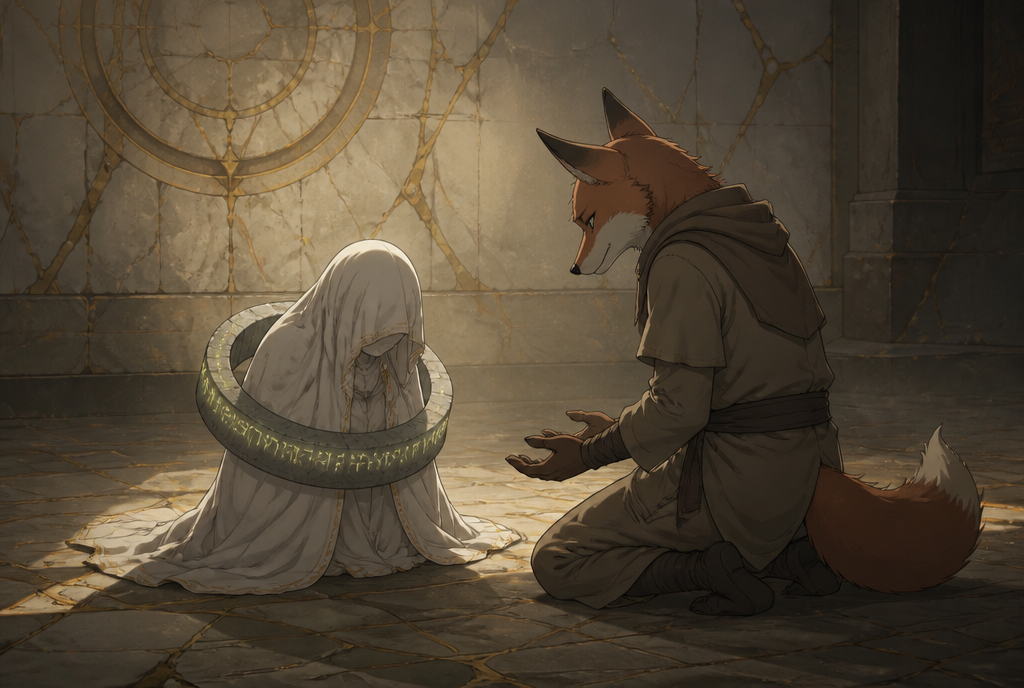
He lifted it from his forearm — it was lighter than it had any right to be, lighter than stone, lighter than promise — and he crossed the small chamber and crouched in front of the Veiled. At this distance he could hear the faint dry drag of the veil where it touched the floor. She was smaller this near than she had seemed from across the room; not childlike, only reduced, as if long years of being spoken of as a force had pressed the person inside her inward.
He raised the collar with both paws. The stone was cool. For one foolish moment he thought his hands might fail in some ordinary bodily way — that the ring would slip, that he would drop it against the flags, that the choice would be interrupted not by conscience or mercy but by clumsiness. It did not. The Veiled bent her head and shoulders to make it easier. The collar slid up around her, under the veil, settling where her neck must be.
Lior set the cylinder-key into the slot and turned it.
The marks on the collar lit up briefly, the colour of moss at the base of the pillar, and a soft sound went through the room — not a crack, not a cry, only the smallest taking of breath. Then the light went out.
The Veiled lifted her head once.
"Thank you," she said.
She said it so quietly Lior almost did not hear it. It was not graciousness. It was not forgiveness. It was only thanks, given cleanly, as if she would not lie even now.
Then she said nothing else, and the veil did not move, and Lior knew with the flat certainty of a door shut all the way home that the silence was permanent, and that he had chosen it for her.
He stood up.
His hand was empty. The cylinder-key was gone — not dropped, not taken; the binding had spent it. The collar around the Veiled's small neck was the only thing left of all of it.
He turned.
Maerun was in the corridor. He had come closer than Sevren had said he would come — close enough that his head was filling the doorway of the chamber, his eyes at the height of Lior's eyes again, the way they had been on the plain.
"Thank you, little one," he said. "Now... we are in your debt. I am in it."
He said it the way he had said Now, like prayer heard through stone. For an instant his face changed — not softer, exactly, but less certain of what relief ought to look like. Lior thought, with no mercy in the thought at all, of the sister who had stood where the Veiled had knelt.
Lior did not answer. He walked under his head, into the corridor, and back along it to the larger doorway, where Sevren had been sitting. Sevren was not on the column any more. The piece of column was not on the column any more. The dead trees were still dead, but the roots were no longer pulling the stone apart — they were holding it, the way a hand will keep holding something it had been pulling, by habit, after the pulling has stopped. The whole place seemed to have gone still without becoming kinder.
Lior walked through the temple's gate. The plain stretched on the other side of it, pale and measureless, but he did not see the plain so much as feel it slip away under him. The gate became another thing. Stone underfoot became another stone, then packed earth. His stomach turned over once, as if he had missed a step in the dark. Time had passed without any fanfare. His body knew it before his mind did: the ache in his calves, the drag in his shoulders, the dust at the back of his throat.
The road came back under his feet.
It was full night now.
Tanen was beside him — not holding his hand; carrying it. He had stumbled, and Tanen had caught him, and for a moment Lior was more aware of the callused seam of his pawpads against his own than of anything else. Around them the column had stopped in a long ragged scatter. People were sitting at the verges with bowls in their laps and blankets about their shoulders; people were half-risen and then sitting again; a horse had one strap half-threaded through a buckle where the otter had stopped in the middle of unsaddling it. All of them, without seeming to mean to, were turned a little east.
The fires of the corrupted that should have been pinking the eastern horizon were not pinking the eastern horizon. The eastern horizon was dark.
For a while no one appeared to know how to behave toward that. Nobody cheered. They only kept looking, as if the fires might show themselves again the moment anyone trusted the dark. An old vole had got to his feet and was shading his eyes against a night that gave him nothing to shade them from. A dog tied to a cart lowered itself onto its belly and put its muzzle on its paws. Somewhere behind Lior a hare-woman said, "No, I saw it at dusk, I'm telling you I did," and another voice answered, "You saw the sunset." The words went on travelling anyway — no smoke now, maybe farther south as well, maybe all the way back to Ardel if anyone dared say Ardel aloud.
A child asked, not loudly, "Does dark mean home?" and was hushed at once, not sharply but with the fearful gentleness people use around luck.
The road itself seemed to slow as the murmur moved along it. People who had been readying packs for first light let them lie where they were. Two of the older men from Ardel stood shoulder to shoulder in the dust, staring east and saying village names under their breath as if testing whether the mouth could bear them again. One of the badgers from the market looked at Lior's face, saw whatever colour had left it, and looked away with the tact people keep for fever or grief.
"You went grey," Tanen said. "For a moment. I thought you were going to faint."
"I'm alright."
"Are you sure?"
"I'm alright."
He kept hold of his paw a moment longer, looking at him and then at the dark east and then back again. Whatever had changed out there had not changed him; he was still measuring the world by the simplest thing first, which was whether Lior could stand upright in it.
Around them the muttering thickened and thinned. Somebody farther down the line laughed once, too quickly, and stopped. Somebody else said there had been no smoke since before sunset. Somebody answered that the corrupted could lie low like foxfire in rotted wood. Nobody knew enough to be certain, and the not-knowing made the dark feel larger rather than smaller.
Then Tanen believed Lior — or chose, at least for now, to believe what could be believed. Lior watched him decide it. He let go of his paw and went back to help the otter with the horse.
Lior sat down at the verge.
He put his paw into his pocket. The pendant was there. It had no warmth.
He took it out and looked at it. The silver was the same silver. The marks were the same marks. The chain was still broken at the same clean ends. But it sat in his palm with the dead exactness of something finished. Before, even when still, it had seemed to incline faintly toward elsewhere; it had held a pressure in it, an inward pull, as if a door on the latch were waiting for the least touch. Now there was nothing behind it. His thumb-claw moved over the grooves and found only metal. The marks were marks. The pendant did not feel as if it knew him any more.
His thumb caught, briefly, on the notch in the iron coin at his wrist. The coin warmed again at once from his skin. The pendant did not.
So this was what a spent silvermark became: not sleeping, not hidden, simply shut. A dead door with beautiful writing on it.
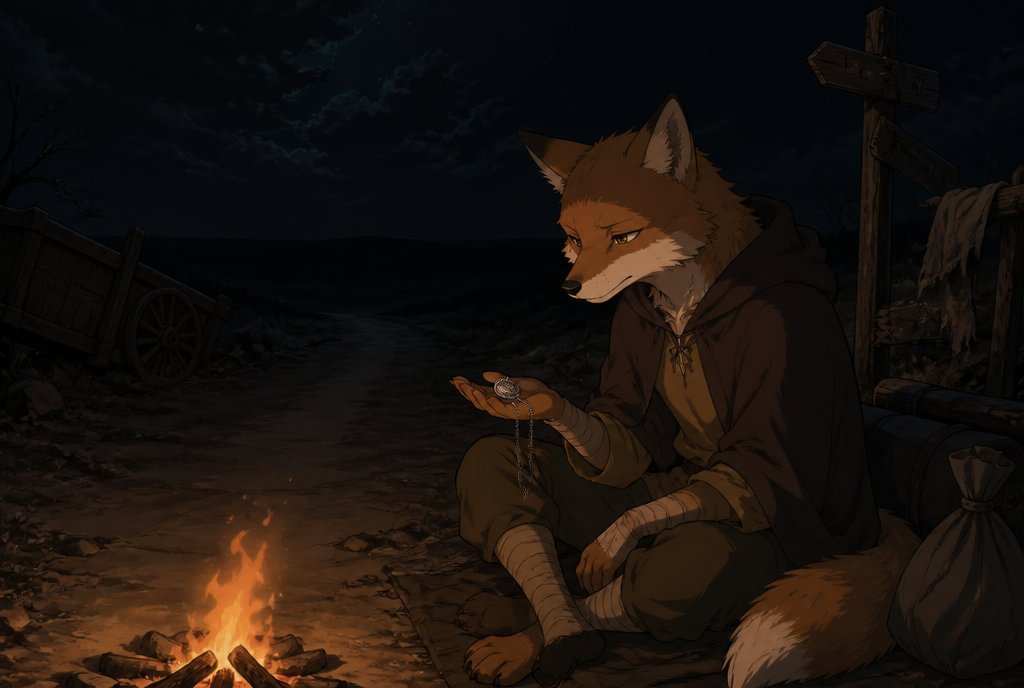
He held it for a long time.
Tanen came back and sat down next to him. He had a piece of bread in his hand that he was tearing in two, and there was ash on one sleeve where he had braced himself by the fire. He gave Lior the larger piece without looking as if he had chosen to do that.
"They're saying nobody's seen smoke since this afternoon," he said. He did not say it as if he believed it. He said it as if he were trying the shape of it in his own mouth, the way a carpenter tests a board before trusting it to bear weight. "Old Hadrik says the glow was gone before dusk. Mira says the south road was black when she went off to piss. Some of the older men are saying we should send a runner back at first light, see if Ardel — they're saying maybe we can — well."
He did not finish. He did not need to. Maybe we can go back. Maybe there is something to go back to. Maybe the word after has not swallowed the whole of the old life.
He glanced down at Lior's paw.
"What are you holding?"
Lior looked at the pendant. For a moment the answer rose in him so quickly it almost passed his teeth entire: A silvermark. A door. The thing I carried into a room under the world and came back from with someone else's thanks in my throat. The relief of imagining the words aloud was sharp enough to feel like hunger.
"Something I picked up," he said.
"At the festival?"
Lior's mouth opened.
Not at the festival, he nearly said. After. Elsewhere. In a place you cannot walk to. Tanen sat close enough that Lior could smell smoke in the fur at his collar and the road-dust in the seams of his coat. His questions were small; they had room in them. It would have been easy, suddenly, to set the whole thing between them and ask him to help hold it.
Instead Lior heard, underneath the ease, the selfishness in it. The choice had been his. Telling him now would not hand him back the lost chance to speak against it. It would only ask him to carry what he had not been allowed to prevent.
"At the festival," he said.
"Show me?"
Lior put the pendant into his palm.
He turned it over. Firelight slid across the marks and made them bright for a moment, but they were only marks, and nothing answered. Tanen frowned at them with the ordinary concentration he gave to hinges, straps, split handles, the small material failures of the world.
"It's pretty," he said. "Was it expensive?"
Lior almost said, It cost enough. The words reached the back of his throat and stopped beside the smaller voice already living there.
"I don't think anyone was selling it," he said.
"You found it, then."
"I found it."
"Well." He rubbed a thumb over one of the glyphs. "You always did come away from fairs with stranger rubbish than I did."
It was not a very good joke. It was tired, and kindly, and made with half his mind still turned east. Lior felt, with a suddenness that hurt, the whole weight of their years together.
Tanen laid the pendant back in his paw and tore off another bit of bread for himself.
"If the dark holds till morning," he said, "they really will send someone south. Probably three someones, so none of them have to be brave alone. If Ardel's still there..." He shrugged one shoulder. "If anything's still there. We might hear by tomorrow night."
Lior closed his fingers around the pendant.
He could tell him now, still. It held a door. It does not any more. I used it, and the thing stopped. He could say that much and no names.
But even that would be a reaching after comfort. It would make him witness after the fact, and it would not ease him. It would ease Lior.
He put the pendant back into his pocket.
The bread was hard. Tanen ate his half. Lior ate his. Around them the road kept talking in its low, unbelieving way. A name would surface — Ardel, Rill, the mill hamlet — and then sink again. No one laughed twice.
In the back of his throat, very small, was a voice saying thank you. The voice would be there tomorrow as well, Lior thought. And the day after. And the year after. Not louder. Not dimmer. Only there.
It was not punishment. It was not even a price. It was simply what remained in him after the choice: a small changed space, shaped like a silence he had made. He would learn it by living inside it, that was all.
The fire on the road went down. People settled by degrees, though not quite into rest. A watch was set without anyone calling it that. Farther along the verge the dog that had been whining east slept at last.
Tanen lay down with his head on Lior's thigh. The eastern horizon stayed dark.
Lior rested one paw lightly on the back of his neck and stayed awake some time, listening to Tanen breathing, and to the wind in the corrupted trees at the side of the road, which was already a smaller wind than it had been the day before. The small changed space at the back of his throat kept its shape without sound.
VI · B. The Bargain
Lior's hand moved to the cylinder-key.
He turned it in his hand. The little cylinder had taken the warmth of his skin. He did not take it to the collar. He knelt, instead, and laid the collar on the floor between himself and the Veiled, and put the cylinder-key on top of the collar, and folded his hands in his lap the way the Veiled had folded hers.
Stone touched stone with a sound no louder than a bead set down on a table. The glyphs cut into the collar did not light. Even so, the chamber altered. Dust along the walls seemed to settle inward instead of down. The worn little figures carved there — processions, kneelings, mouths open where whole faces had been chipped away — looked, for the first time, less like warning than record. Something had been done this way before. Perhaps many times. Perhaps long enough ago that only the room remembered.
"I want to make the second one," he said.
"Then we will make the second one," the Veiled said.
"I don't know what the price is."
"We will say it. That is the binding." She tilted her head. "Not thought. Not meant. Said. We say what we will give, and what we will not give, and what the other will not ask. The room keeps such things when they are said plainly. When we have said it all, we will both know it. Then it will be done."
She waited. She did not seem in a hurry.
Lior thought of Tanen's paw. He thought of the chipped enamel ring on his right paw. He thought of the wandering tune at the cross at Ardel and of the cheesemonger's nod and of the cheesemonger's house, which was not standing any more. He thought of the small figures in robes carved into the lintel of the temple, processing toward a centre that had been chipped away. He thought of Sevren on the broken column, saying that leaving had been a different kind of harm. The thought steadied him. This was not cleverness. It was only the refusal to do a thing blindly.
"The corruption in my realm," he said. "You will withdraw it. Slowly, you said. Over weeks."
"I will."
"Without anyone else having to be hurt by the withdrawing."
"Yes."
"You will not start it again. You will not do anything in my realm, after this, unless I ask."
"I will not."
Each answer came back at once. The chamber did not give him an echo. It only seemed to take the words into the carved stone, as if the figures in the walls had open mouths for that purpose.
"And in your realm — I do not know what you should do in your realm. I do not know enough to say."
The Veiled laughed once. It was not a happy laugh, but it was a laugh.
"That is a fair thing to say," she said. "We had forgotten anyone might say it so cleanly. I will tell you. In my realm I will go quietly. I will not be Veiled any more. I will be a small thing in a small place, and I will speak to no one for a long time, and then perhaps I will speak to one, and we will see what happens."
"Will that be prison again," Lior said, "if you choose it yourself."
"No," said the Veiled. "Quiet is not the same as being kept."
"Alright," Lior said.
"What will you give," the Veiled said.
Lior had been waiting for that one. The waiting had sat under all the other terms like a stone under shallow water; he had seen it the whole time.
"I do not know what I have to give," he said.
"Yes you do."
"Tell me."
"You will carry my name."
Lior looked at her. The veil did not lift. The collar on the floor lay between them like a second mouth, closed. Dust had gathered in the cut lines of its glyphs. At the word name, some of that dust slivered free and settled again.
"Your name."
"Yes. My true name. Not the thing he calls me. Not what has been left of me in this room. I will tell it to you. You will not write it. Stone keeps written things too well. Ink keeps them badly. You will not speak it to anyone. You will keep it at the back of your mouth where you cannot lose it. You will take it home with you, and you will live with it, and you will die with it, and when you die my name will die with you. That is the price."
"Can a name be taken like that."
"Anything that can be called can be taken," the Veiled said. "Anything taken can be kept, if someone keeps it."
"Why."
"Because I have not had a name in a very long time. He took it from me when he made the binding. I would like a name to be in the world somewhere, even if it is only ever known by one. There are old forms for such keeping. This room remembers them better than he does. It is a small thing. It is also the only thing I have to ask. I have nothing else."
"That's the whole price?"
"That is the whole price."
"What if I tell someone. What if I tell my brother. What if I am in pain one night, and I tell him."
"You will not."
"How do you know."
"Because you will love that you are the only one who knows," the Veiled said. The cloth at her throat moved once with the breath of it. "It will become a thing you love. It is a small selfishness. I am giving you that as well, with the name."
Lior did not have an answer to that.
"There is one more thing," he said.
"Tell me."
"He should know. About the second one. That you and I made it."
"He will know."
"That isn't enough. I want him to be able to say no, to it, before it sets."
The Veiled was silent for a long moment. Then she said, "You are the second one I have ever known to ask that. The first came before Sevren, when the lintel still kept more of its faces. They asked as if they had already been denied the same mercy somewhere else."
"Was Sevren the first."
"No. Sevren did not ask. He did not know enough to ask. Sevren wanted to leave so as not to do me harm, and he did me a different kind of harm by it, but he was a kind boy, and he did not know."
"Who was the first."
"You do not need to know."
"Alright."
"He may say no," the Veiled said. "If he says no, the binding fails, and we will all of us be where we were a moment ago. The room will not pretend it did not hear him. That is the price of letting him in. Are you willing to pay it as well."
"Yes," Lior said.
"Then call him in. Call him by his name."
"I don't know his name."
"You do. He told you. Maerun."
"Maerun," Lior said.
The doorway of the chamber filled with him. He had been waiting. One long-fingered hand was braced against the carved stone of the jamb, hard enough that the dust there had smeared under it.
"I am here," he said.
"There will be a different binding," the Veiled said. "Lior has asked it. I have agreed. He has asked that you may say no to it before it sets. Do you say no."
Maerun did not answer at once. His eyes went first to the collar on the floor, then to the key laid over it, then to Lior. The hand on the stone curled once, as if the carvings had caught him there. He looked at Lior longer than at the Veiled.
"I want to know what it costs," he said.
"It will cost the speed of the withdrawing," the Veiled said. "The fires will go slowly, not at once. People in his realm will die in those weeks who would not have died if the collar had been used. Lior knows this. Lior has not flinched."
Maerun's eyes did not move from Lior.
"And what does it cost you," he said, to Lior.
"My name," the Veiled said, before Lior could answer. "My brother will carry my name."
She had said brother. Lior had not corrected her — had not even thought to — and the word stayed in the chamber between the three of them like a third object set down on the floor. Maerun was her brother, Lior understood at once; and now, by the same word in the same mouth, so was he. He had been called brother in his life only by Tanen, when Tanen was frightened. To be called it now, by a small veiled thing who needed somebody to keep something for her, was a different shape of the same word. Not destiny. Kin. Older than kinds.
"And what do I get to know," Maerun said.
"That she went quietly," the Veiled said. "That I went. That there is no longer anyone to bind. That you may stop praying."
Maerun was silent for a long time. Then his hand left the stone and came, almost absently, to the centre of his chest, as if to make sure something there was still answering him.
"Sister," he said. The word seemed to catch in him on the way out. "We have not — I have not stopped praying for the one I lost."
"I know," the Veiled said. "I know. You will go on praying for her, and that is between you and her. But you will not pray for me any more. I am not lost. I am only quiet."
Maerun closed his eyes.
"I do not say no," he said.
"Then it is set," the Veiled said. "Lior. Come closer."
Lior went. The floor was colder near her. He could hear Maerun breathing in the doorway behind him, slow and careful, as if he did not mean to disturb anything that was being finished.
The Veiled lifted her veil — only the lower edge, only enough to bring her mouth close to Lior's ear. The cloth brushed the outer fur of his ear, no more than that. She said her name.
It was not a sound Lior had heard before. Some part of the chamber had. The carved mouths in the walls seemed, for an instant, to have been waiting for exactly that shape of sound. The name went into the back of Lior's mouth at once, not as if he had memorised it, but as if it had known where it was meant to be kept.
Lior took it.
The collar on the floor between them did not crumble all at once. A hairline crack ran along one carved line and then another. Stone gave way without violence, settling down into pale dust that still held, for a breath, the shape of a ring. The cylinder-key went after it. Its gold dulled, roughened, and let go of itself into a finer ash-coloured dust on top of the first. The chamber did not have any wind in it. Nothing stirred. Two ended things lay where they had been laid.
The pendant in Lior's pocket was very warm.
When Lior next looked up, he was on the road.
It was not yet dawn.
For one bewildered beat he thought the bargain had thrown him backward. Maerun had said, on the plain, that time ran faster there. It should not still have been this watch. Tanen should have handed it over already. The east should have been lighter, or the camp properly waking. Instead the silvermark had returned him to the very hour he ought to have lost, as if the bargain had reached into the slip and pinched part of it almost closed.
Tanen was beside him, awake — not asleep at all; he had been keeping watch — and he saw his face and put his paw against the side of his muzzle without saying anything. His pads were cold from the night air. That small cold touch was more convincing than the road under Lior's feet.
"Brother," he said, after a moment.
"I have a lot to tell you," Lior said. His voice came out rough. The true name sat behind it like a held breath.
"I will believe most of it," he said. He did not take his paw away. "I will try."
"Most is enough."
Around him the road was in watch-silence: somebody coughing in sleep farther down the line, a horse stamping once, a kettle settling on dead coals. At the verge, not far from where he stood, a young birch had grown wrong. Its bruise-coloured finger-branches were black against the eastern dim. Yesterday such branches had not moved when the wind moved. Now, while Lior looked at it, the outermost spray shivered once in the small cold breeze. Only once. Only a little. But it moved like a branch, not like a waiting hand.
Tanen followed his eyes. "What is it."
"I think," Lior said, "it has started."
He looked from the birch back to him, and whatever disbelief he had ready did not quite survive the sight of his face.
"Then tell me from the start," he said.
So they sat on the verge together, because the telling felt like something done sitting down. Tanen kept one paw over Lior's while he spoke, as if he meant to hold on harder this time if Lior vanished sideways again.
Lior started with the silver in the grass at the festival. He told him about the plain, and the pillar, and the creature who had a name after all. He told him about the month returning to him on the road. He told him about the temple, and Sevren on the broken column, and the small chamber whose carvings seemed made to keep promises. He told him, carefully, about a being who had not asked for pity and had gone quiet by her own choosing. He told him about Maerun standing in the doorway and being allowed, for once, not to choose for somebody else.
Each time the telling came near the true name, Lior felt it settle farther back in his mouth, not fighting him, only refusing to be offered up. He stepped around it the way a person steps around a sleeping animal in a dark room: carefully, with love, knowing the shape without touching it.
Tanen did not interrupt often. Once, when Lior said the plain had no horizon he could trust, he frowned as if trying to fit that into any world he knew. Once, when Lior said that a whole month had happened to him and only later come back, he shut his eyes and nodded once, because that at least explained the look Lior had worn all day. When Lior said the fires would not stop at once, only withdraw, his grip tightened on Lior's paw and then gentled again.
"I don't understand all of it," he said when Lior paused.
"I know."
"But I believe that something answered you."
"Yes."
"And I believe you came back."
"Yes."
He leaned his shoulder lightly against Lior's in the watch-cold before dawn. "Then most is enough."
The Veiled's name stayed at the back of his mouth, where he did not lose it.
VI · C. The Refusal
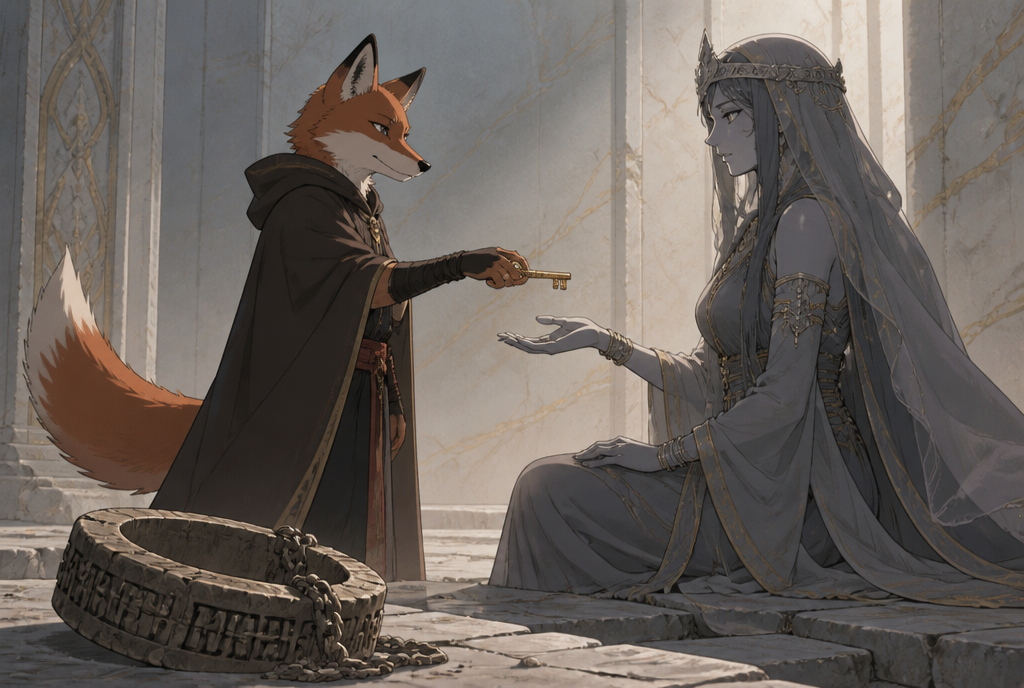
Lior's hand moved to the cylinder-key.
He turned it once in his fingers, feeling the shallow ridges catch at the pad of his thumb, and crossed the small chamber and put the cylinder-key into the small unseen hand of the Veiled.
The Veiled closed her fingers over it. For a moment nothing happened. Then a thread of gold showed between her fingers, thin as light under a door. It ran over her knuckles, lit the hem of the veil where it touched her wrist, and went out. When her hand opened again there was no key in it. Only the brief pressed dent of it remained in her palm, already fading.
The collar on Lior's forearm — he did not take it off at once. He stood with it a moment longer, the stone weight of it against his sleeve, and then he unhooked it slowly, as a person unhooks a satchel they have been carrying a long time, and he laid it on the floor, in the centre of the room, where it struck once with a sound too small for what it was, and where it would be the first thing anyone entering would see.
"You are sure," the Veiled said.
"No," Lior said.
"That is the right answer," she said. "You may go."
Lior turned.
Maerun was in the doorway. He had come closer than Sevren had said. His head was filling the doorway. His eyes were at the height of Lior's eyes, the way they had been on the plain. One foreclaw was set against the stone so hard the old carving had powdered under it.
He did not speak.
Lior walked under his head. Lior had to duck a little, because the doorway was not made for a head that big, and his lower jaw brushed Lior's shoulder as he passed. The brush was as light as a moth. Lior had not expected him to feel like that.
In the corridor he turned to watch Lior go. He did not follow. He did not stop him. By the time Lior reached the next doorway he could feel his gaze no more than the weight of weather at his back.
At the larger doorway — the temple's gate — Sevren was sitting on the broken column, exactly as he had been before. His arms were on his knees. He was not quite solid.
"I knew it would be you," he said. "I'm sorry. I shouldn't have. I thought it when you asked me why I was telling you, instead of how to make the collar work. The ones who mean to use it want certainty. You were listening for the cost. I knew it the second I saw you."
"Knew what."
"Which one you were going to do."
"You don't know."
"I do."
Lior did not argue with him. He walked under the carved lintel, past the dead trees with their bruise-coloured roots, out onto the plain that was not the plain of the pillar — this plain was browner; the grass came only to the ankle; the small blue flowers were not anywhere — and the plain became the road.
It was day. Bright day. The column was halted. People were looking east — every kind of them, ears forward, muzzles tilted. Nobody was speaking above the voice they used for the sick. A cartwheel complained each time somebody shifted the weight in it. Somewhere ahead a woman called for water. Somewhere behind them a tethered dog gave a low, steady growl toward the horizon and would not be quieted.
The fires on the eastern horizon had not gone out.
They had grown.
They were no longer only colour. Under the long red seam of them, the tree-line was wrong now even at this distance — not crowns but dark forks, a crawling fringe of root-fingers dragging upward out of the land. Every so often something in that brightness cracked. The sound came a moment later, small and flat with distance, not thunder and not woodcutting either. Near the front of the halted line one of the scouts was trying to tell the carters what he had seen and could not remember the name of the place he had come through; he kept calling it the village with the mill, the village with the green door, as if the name had been taken out of him on the road. The donkey at the otter's cart had planted all four feet and was showing the east all the white of one eye. There was a taste in the air like old pennies and wet ash.
Tanen was a little ahead of him in the column, with the otter who had a donkey-cart, helping the otter tie a loose strap. He looked up when Lior staggered, and he came to him at once, and the otter did not call him back; nobody on the road called anyone back any more.
"You alright," Tanen said.
"No," Lior said.
He stopped. He had been about to say something else — Lior could see the small joke arriving in his eyes; he was always reaching for the small joke — and he did not say it. He looked at Lior properly.
"What happened," he said.
"I did something," Lior said. "And I undid it. And I have to tell you."
"Now?"
"Now. Before the next thing happens."
He looked east once, the way a person measures weather, and then back at him. "Alright."
He sat down in the dust at the verge of the road, half in the wheel-rut and half in the dead grass. The ground was warm on top and damp underneath where the night's cool had not quite gone. Tanen folded himself down beside him, knees up, one paw still on Lior's wrist as though if he let go before the telling was done Lior might slip away again.
Lior did not know how to begin, so he put a paw into his pocket and took the pendant out and put it in Tanen's.
"This," he said. "I picked this up at the festival."
The pendant was cool in his palm, but not empty-cool, not yet. The cold in it was moving. Lior could feel it even after it had left his hand: a slow draining from the glyphs outward, as if the silver were remembering how to be only metal. Tanen turned it once under the day, and a pinhead warmth still clung to the broken loop of chain. By tomorrow that too would be gone.
"What is it."
"I don't know what anyone calls it," Lior said. "I know what it does."
Then he told him.
He told him about losing the festival while still standing in it. About the plain and the standing stone and Maerun draped there like a prayer somebody had forgotten to finish. He told him about time moving wrong, and about being sent back to find Ardel already burned in the month he had not lived through properly, and about walking beside Tanen all yesterday with the secret knocking at the back of his teeth. He told him about the temple, and Sevren on the broken column, and the dead roots climbing stone like hands that had never learned how to stop reaching. He told him about Maerun's sister, and the first binding that had already taken one life to make another silence. He told him about the Veiled, small under her cloth, and the three things she had offered. He told him Maerun had wanted one answer and the Veiled another, and neither of them had lied, and that made it worse. He told him which answer he had chosen. He did not spare himself any part of the telling. When he reached the why, he said it plain.
"I could not put a collar on her," he said.
Tanen's grip tightened once on the pendant. He did not ask him to say it differently.
He told him about the key vanishing in her hand. He told him about the collar on the floor. He told him about Maerun standing in the doorway and not stopping him. He told him the fires had not stopped and would not stop because of anything he had done. He told him everything.
He was holding the pendant in one paw and Lior's paw in his other. He had not spoken once. He did not ask whether any of it was real. The road had saved them that trouble.
When Lior was done, he was quiet for a long time. A cart moved somewhere behind them with a noise like a groan. Dust settled on Tanen's knee. He kept rubbing his thumb over the broken place in the chain as if it might tell him something more if he worried it long enough.
"How long," he said, finally. "How long do we have."
"I don't know."
"Less than to Eshea."
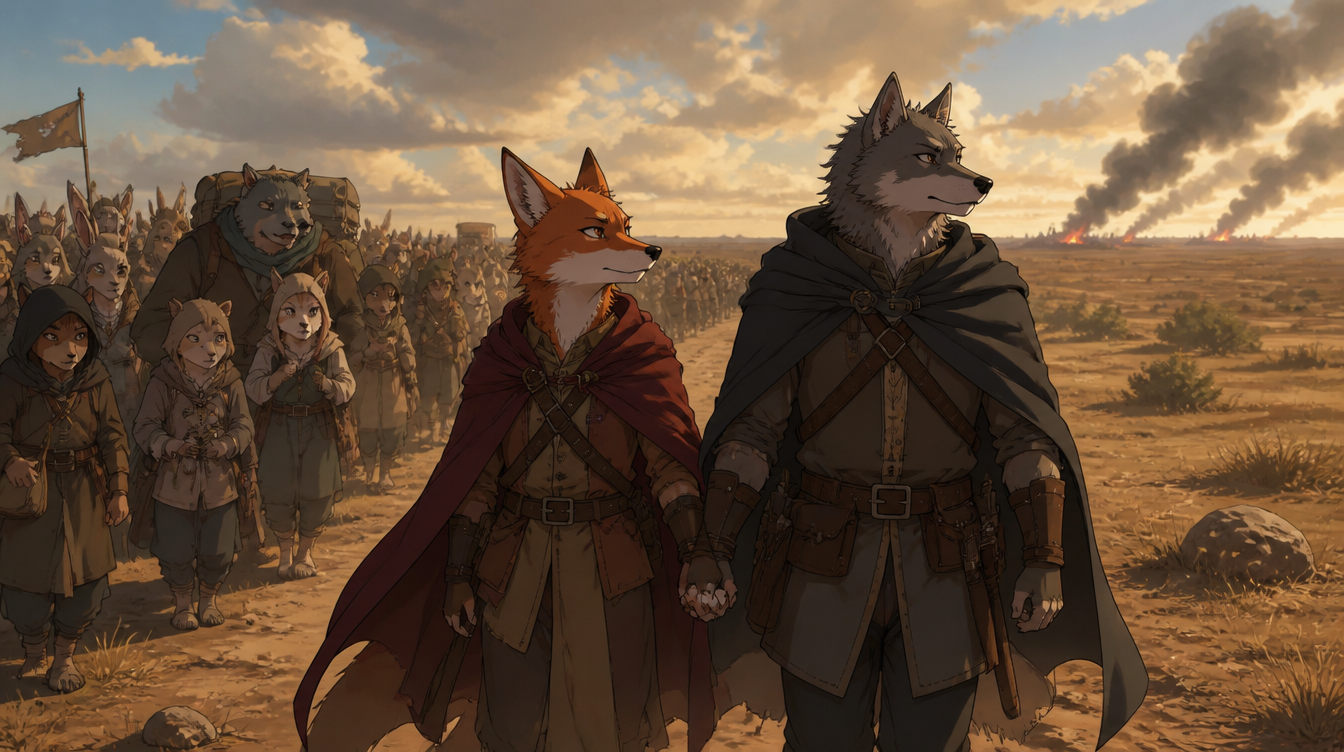
"I think so."
"How much less."
"Three days. Maybe."
He breathed out. His ears went back. Then forward again. He looked east and then at Lior and then down at the pendant.
"Brother," he said. "You should have told me on the road yesterday."
"I know."
"You should have told me, and I should have had the chance to answer before you went back in there. Not because I could have made it better. I don't think there was a better. I just—" He stopped. Started again. "I keep thinking of you carrying that beside me while I was talking about straps and bread and where we might camp, and I hate that. I hate that you were alone with it."
"I know."
"You should have told me, and I should have said do whichever one of the three lets you keep your face. I would have said that. No — I know I would have said that. I would not have said put the collar on her, even to live. I am almost sure I wouldn't have said it. But I should have had the chance."
"I know."
He laid the pendant in Lior's paw and closed Lior's fingers around it.
"Alright," he said.
Then he said, "Alright," again, because the first one had not done all the work. He put both his paws around Lior's closed paw around the pendant, and he held them there. His pads were rough with carpentry-callus and road-dust. He held them there until Lior stopped shaking, which he had not noticed he was doing, and then for a little longer than that.
"Are you angry," Lior said.
"Yes," he said, with no heat in it at all. "At you, a little. At the whole shape of it, mostly. I can be angry and still come with you."
He looked toward the east again. The scout at the front of the road was still trying and failing to name the place he had seen.
"What does it do," Tanen said, quietly, "when it gets close."
Lior swallowed. "It takes names first. Then faces. The roots go through walls. Animals stop being afraid of the right things."
Tanen nodded once, like a carpenter checking a measure he hated and trusted. "Then we don't wait for it to ask ours."
"Three days," he said. "Three days is a long time."
"Yes."
"We can do a lot in three days."
"I don't know what there is to do."
"We can carry water. We can pull a cart out of mud. We can get one family turned onto a side road in time. We can find people who would rather not run. You always said there must be people who would rather not run." He swallowed. "Three days is a great deal of time if we stop spending it pretending north is going to save us."
Lior looked past him at the northbound line of carts and bundles and bent backs. There were hundreds of people on the road, all of them making the same shape with their fear. The thought of stepping out of that shape made his stomach go hollow. That was how he knew it was a real thing Tanen was offering, and not a comfort.
"Tanen."
"What."
"We can't outrun it, can we."
"No," he said. "I don't think we can."
He stood up. He pulled Lior up by the hand. He brushed the dust off his trousers with his free hand, in the careful absent way he always brushed dust off his trousers — Lior had watched him do that gesture in fifty kitchens and a hundred mornings, and watching him do it now, on the refugee road with their world ending in three days from the east, made the old brother-love in him rise so hard he did not know how to hold it.
"Eshea is north," Tanen said. "The fires are east."
"Yes."
"If we keep walking north, then we do what everyone else is doing and hope the road is longer than the thing behind us."
"Yes."
"I am tired of hoping like that," he said. "Let's go east."
Lior looked at him. He was not joking. He was not deflecting. His eyes had found Lior's for the first time in a month.
"Alright," he said.
"Alright?"
"Alright."
They turned, together, against the column. It was only a change of direction. It felt larger than the temple.
They stepped past bedrolls, past a stacked cage of hens gone silent, past the front wheel of the otter's donkey-cart. The otter looked from Tanen to the east and understood at once. His mouth opened as if to call them back. What came out instead was, "Tanen."
Tanen looked over.
The otter lifted one paw, not waving, not blessing either. Only marking that he had seen. Then he turned back to the strap in his hands, because there was nothing else to do.
A hare woman with a child moved aside for them with the careful room people make for the fevered or the condemned. Nobody argued. Nobody asked them where they thought they were going. The whole road leaned north; only the two of them leaned east.
The pendant was cool and cooling still, the last small warmth shrinking away under Lior's thumb. Soon it would be only silver. The iron coin at his wrist was cold the way it had always been. After a dozen steps the air tasted more strongly of ash. Tanen's paw was in his.
They went east together.
Alternate Routes
Arm T. The Hawk's Bargain
The road slept badly.
Even when the column stopped, it never quite became still. A horse shifted in its traces. Somebody coughed. The saucepan under the goat carter's axle gave one thin knock. Ash in the little cookfires went black and then red again by fits.
Lior was asleep on the blanket beside Tanen, one paw under his cheek, the other open on the cloth. The iron coin at his wrist lay dark in the last of the firelight. Tanen looked at it once and away. That was not his to touch.
The silver was something else.
It was in the inside pocket of Lior's coat. He knew because Lior's hand had kept going there all day, thumb finding the pendant through the cloth. Found in the festival grass. Not earned. Not given. A thing from outside the life they had made, and a thing that had already taken a month from him and laid it back down wrong.
Tanen had been thinking for days without letting the thought have words. The road had done it. Mile by mile the idea had kept pace just outside speech: if the silver could take a soul where bargains were made, perhaps a bargain was not only one bargain.
He had not told himself what he wanted. He had not needed to. It had his sister's shape whether he named her or not.
Eastern marches. Smoke over the low forts. A cart coming back without her. Too much confusion, people said, to know which ditch, which field, which body. Maybe not body at all. They had said maybe so often it became the grave.
Lior breathed beside him, small and tired. Tanen had been so busy keeping the next ten paces possible that he had not let himself look farther away than morning.
Now he did.
It was a terrible thing to do. He knew that before he moved. The knowing did not stop him.
Very carefully, so carefully that it felt like a kind of prayer made wrong, he slid his paw into the inside pocket of Lior's coat. Lior made a small sleep-noise and turned his face farther into the blanket. Tanen stopped breathing. The road held still with him.
Then his claws found the chain.
He drew the silvermark out by inches. It lay in his palm at last: cold, small, heavier than its own size. The cut marks along it caught what little firelight there was and kept it badly.
Lior did not wake.
Tanen closed his paw around the pendant and got to his feet.
He counted twenty paces off the road because counting was a carpenter's habit and because if he did not count he thought he might turn back. At eighteen he thought of his sister climbing onto the cart for the marches as if she would be back by supper. At nineteen he thought of Lior sleeping with one empty pocket. At twenty he reached the broken wagon-wheel somebody had left against a hedge and sat down with his back to it.
The night was ordinary there. Hedge. Ditch. Cold earth. Damp canvas on the wheel-rim. Tanen opened his paw.
He had watched Lior look at the silver enough times to know what looking meant, or thought he had: not staring, only a refusal to let the marks become scratches again. He fixed his gaze on them.
The marks turned.
Not on the pendant only. In him. The wheel forgot it was wood. The ditch forgot which way down was. The dark unstitched itself from field and sky. Tanen had one startled instant in which he knew what Lior had meant by the road ceasing to be the road.
Then he was elsewhere.
The plain went on farther than sight trusted. Grass came to his shins, then his knees, then no higher than his ankles depending on the step. Blue flowers stood among it like small decisions left unmade. The sky was bright and overcast and gave nothing back. In the middle of it all rose the pillar, very tall, mossed green at the base, its cut marks moving in and out of sense as if the stone were turning a tongue too old for speech.
Someone was praying.
Tanen went toward the sound because there was nowhere else to go and because he had come for an answer, not a revelation. Distance folded badly around the pillar. He crossed more ground than he should have, and less. When he came round its flank he saw Maerun draped along the stone as if the pillar had grown a living sorrow at the top of it.
The prayer stopped.
The great head lowered. Those moss-green eyes fixed on him. For one moment Tanen nearly lost his nerve, not from fear exactly but from the shame of arriving where he had not been invited.
"Little one," Maerun said, and the voice came through the air as through a wall, prayer-muffled even now, "you are not the one I have been waiting for."
"I know," Tanen said.
His own voice sounded very small there. He kept holding the silver. He did not say his name. He did not say Lior's. He looked at the moss at the base of the pillar instead of at Maerun's face and said, "I came to ask for something different."
Maerun came down from the pillar with that same impossible economy Lior had tried and failed to describe on the road — there, and then nearer, and then low enough to speak. Up close, the creature's stillness was worse than movement would have been.
"Now..." Maerun said. "Different from what I asked is often different from what can be given."
"I know that too."
He stepped closer anyway and bent his head. What he wanted did not belong in the air of the plain. He said it low, for Maerun only: what had been lost, the eastern marches, his sister, the impossible thing plainly at last.
Maerun did not move for a long time. Only once the great head turned toward the far side of the pillar, as if listening for an interruption that did not come.
When he looked back, something in the old grandeur had gone thin.
"I — we — I do not know if this can be paid in your coin, little one," he said.
Tanen lifted the silvermark in both paws. "Then take this. Take the crossing. Take whatever it costs after. Only don't tell me no before you've looked."
That was not all he offered. The rest remained between them. Maerun heard it. His eyes closed once, as if against weather.
"Now... little one," he said. "There are asks the world should not answer merely because it can."
"I know."
That was the last true chance for mercy.
Maerun could still have said no. The whole plain seemed to wait on that one withheld kindness.
He opened his eyes.
"Yes," he said.
The horror of it was clean.
No thunder followed. Only the acceptance itself, and the knowledge in Tanen that love had been allowed to go as far wrong as it wished, provided it paid. The pillar's marks stirred once. The silver in Tanen's paws burned cold.
What passed after did not pass in words the plain gave back.
When Lior woke, the dawn was grey and thin and mean.
His hand went to the inside pocket before his eyes were fully open.
Nothing.
For one stupid second he thought he had only missed the pocket seam. He pushed harder, found lining, old thread, the inner fold where the chain liked to catch. Empty. His stomach dropped. He sat up too fast and the world went white around the edges.
The blanket beside him was cold.
Not just untidy. Cold. Tanen's bedroll had been rolled badly and left by the cart-wheel. His cup was gone. His coat was gone. The small knife he kept tied into the tool-wrap was gone. Lior looked at his own wrist at once, without knowing why, and found the iron coin still there against the skin, dark and familiar and untouched.
The silver was the only thing missing.
Around him the camp was becoming a road again. People stamped life back into their feet. The goat carter was already swearing at his rope. A child cried because the porridge was too hot. Ordinary sounds. Wrong morning.
Lior got up.
"Have you seen—" he began, and stopped. The sentence would have made Tanen missing in other people's mouths. He was not ready for that.
He looked behind the carts, by the hedge, toward the ditch. Water, perhaps. Pissing. Some practical errand followed too far. The empty pocket said otherwise.
Lior counted four breaths under his breath and found he was already on seven. One and two, three and four. His throat hurt.
At the side of the road, where the ditch deepened and the grass had grown over last week's washout, the air had come apart.
Not wide. Not like a door. A crack only, thin as a knife-slit in glass, except that glass would have shown light through and this showed a greyer grey, a brightness with no morning in it. Something pale moved in that slit and then was standing half out of it, half still elsewhere, as if the world had failed to decide which side of itself she belonged to.
The Veiled held the cloth about her with one small hand. The lower edge of it stirred without wind.
Lior stood very still.
"You think we are grief making a shape at the verge, Lior, isn't it so?" she asked.
Her voice was as soft as it had been in the chamber. Softer, perhaps, for being out of place here among the road-noises and buckles and tired animals.
Lior's first thought was that she was right.
His second was that if grief had learned to speak in that voice he was in deeper trouble than any of the others knew.
"No," he said.
Then, because the first no had not done all the work: "No."
The Veiled inclined her covered head by the smallest degree.
"He took your silver in the night," she said. "He went to the pillar. The keeper received him. He asked for his sister. The keeper said yes."
Lior did not understand the sentence all at once. It arrived by pieces, each piece absurd on its own account.
"Tanen wouldn't."
"Wouldn't call it stealing," the Veiled said. "No. That is part of the trouble."
Lior looked past her at the crack. The grey in it was not empty. It had depth. The ditch grass nearest it had gone colourless at the tips.
"You're lying."
"We have lied by silence before," she said. "Not in this. He crossed without leave. The seam is wider now. That is why we can stand this near your road."
Lior's paw closed on the iron coin at his wrist so hard the edge bit. The pain helped almost not at all.
"Where is he?"
The Veiled was quiet for a moment while the road behind Lior began to creak into motion.
"Not where he left you," she said. "Bargains do not always return a person to the place they were foolish in. He asked for what had been taken east. East is where the answer went to meet him."
Lior thought, with savage gratitude, then he's dead.
If he was dead, then this could still be grief. If he was dead, then the rest of it had not happened.
"You would rather he had died than done this," she said. Not accusing. Plain.
Lior said nothing.
"We do not blame you," she said. "That would be the kinder shape."
The column lurched. Somebody called for walkers to close up. The old vole couple were already moving. The road did not pause because one life had gone wrong in a fresh direction.
Lior swallowed.
"Why tell me?"
The cloth over the Veiled's shoulder lifted and settled with her breath.
"Because the keeper should not have said yes," she said. "Because the crack is wider. Because warning is what we have, when warning is late."
Then she stepped back, or the crack took her; Lior could not tell which. The grey slit drew thin again. The ditch was only a ditch. Only the colourless grass-tips remained, and those might have been frost if it had been that kind of morning.
Lior stood one breath too long, then turned and went back to the road.
He did not tell anyone Tanen was missing.
He walked.
That was the worst of the morning. Not the fear. The walking. Left foot. Right foot. Dust. Cart-rattle. The whole column doing what columns did when nobody important had ordered it otherwise.
Lior kept waiting for Tanen to appear with some practical explanation in his face. Water. Wood. A wheel-pin. He kept waiting for the silver to show itself after all in some seam he had missed.
Neither happened.
By midmorning he had made room in himself for another thought. Perhaps Tanen had gone after the silver and been lost in the dark. Perhaps he had slipped in the ditch, and everything at the verge had been the shape grief made when it could not bear a plain thing. Perhaps he had been tired enough to dream standing up.
It was a small mercy.
He held onto it until the sun climbed and the east began to go wrong.
Not fire. Not smoke. Worse. The horizon there looked wetted through with something dark and slow. Once Lior saw a flock rise from that direction and wheel back on itself without crossing whatever line it had met in the air.
His mercy went out at once.
At noon the road widened over a long bare stretch where last year's ditching had failed and the banks had not held. Heat sat low over the ruts. The column thinned without breaking. Lior had drifted toward the left verge to let an ox-cart pass when he saw someone walking toward him from the east.
Too far at first to be anyone. Only a figure where no figure should have been, coming from the wrong direction with the wrong light behind it. Then the stride resolved. Broad shoulders. Familiar coat. Head bent a little, not from weariness only but because of what was cradled in his arms.
Lior stopped dead in the road.
Tanen saw him almost at once.
He stopped too.
The column did not. People split around them with the blank competence of the tired. A cart swayed wide. The goat carter cursed and kept moving. Dust moved around Lior's ankles.
Tanen stood twenty paces away.
His coat was wrapped around whatever he carried. He held it with both paws, close and careful, as if it were breakable or sleeping. The shape under the coat was small. His face looked as if hope had been turning into fear and back again all morning and the muscles had forgotten which shape to keep.
Behind him the eastern horizon moved wrong. The dark worked under distance. The far trees would not hold their own edges. Whatever had been paid had not been paid neatly.
Tanen looked at Lior's face first. Then at the empty place in Lior's coat pocket. Then back.
There was no triumph in him. Only a terrible hope, and under it the knowledge that he had crossed a line and come back carrying the proof in his arms.
Lior understood then, with the cold exactness of bad news in its final form, that this had not been done against love. It had been done by love allowed past its proper edge. That was what made forgiveness feel possible and impossible in the same breath.
His hands had gone numb. He could not tell whether he wanted to reach for him or strike him or only stand where he was.
Tanen's mouth opened.
Not on apology. On the old worried word he had not used since the night he put his paw into Lior's pocket and took the silver. It rose into his face and failed there.
Lior looked at him, and at the small wrapped shape in his arms, and at the corruption moving low on the horizon behind him, and the whole column went on around them as if they were two stones in a river.
Appendices
Characters
Lior — fox
A young adult russet-furred fox. Slim build, ears upright and expressive, tail kept low in public. Headfur worn pulled back. The iron coin at his right wrist — hammered, blank-faced, with a single notch from the well-rope on the eastern marches two summers back — is always cold. He says alright instead of okay, counts under his breath when frightened, and ends sentences with I think when he is sure.
He is the one this story is about, though he would not have put it that way.

Tanen — wolf
A grey wolf, broader than Lior. Warm grey-brown coat, the muzzle going lighter under the jaw. Carpenter's calluses on his pawpads from carpentry. He deflects fear with small jokes that arrive a moment too dry. He calls Lior brother only when he is worried. He trails off when he is telling the truth.
Boyhood friend; brothers-in-arms after a regional militia call-up to the eastern marches two summers back. The campaign took his sibling. They do not talk about it together.

Maerun — the Pillar-Keeper
Enormous. The lower half of him never fully seen, even when he stands. His voice is muffled like prayer through a wall. He begins difficult sentences with Now…, calls Lior little one, and uses we when he means I and I when he means we — a grief no one has corrected in a long time. Not anthropomorphic; older than the kinds. He prays at the pillar.

The Veiled
Small. No larger than a kit. Wrapped head to floor in a thin grey cloth that moves a little with her breath. The veil never lifts on the page — except, once, only its lower edge. She is whisper-soft, plural, ends questions with isn't it so?, and uses Lior's name only at moments of leverage. Also not anthropomorphic. Older than the kinds. Imprisoned for what she was, not for what she had done.

Sevren
A young fawn-coloured deer, small antlers still in velvet at the tips, dressed in archaic clothing no one in Ardel wears any more. Translucent. He was a pendant-taker, once, and he chose not to leave. He warns without insisting. He has been on the temple side of the door for a long time and he is not going back.

Images marked "placeholder" will be regenerated; current illustrations are from the chapter plates so this appendix is never broken-image during regeneration.
Places
Ardel
A pre-industrial village near the woods, north and slightly east of where the corruption began. Mixed-species population — foxes, wolves, badgers, hares, otters, deer, and others. Tech-floor: paper, glass, iron, no gunpowder. The midsummer festival is the village's oldest custom: bunting along the temple eaves, a drum-and-pipe player at the stone cross, the cheap honey-wine the otter boy pours, the badger cheesemonger's nod that is the highest praise she gives.
By Beat 3 of the story, Ardel is ash.

The Plain (Realm of the Unseen)
An open plain in the Realm of the Unseen — a parallel layer that touches the home realm at certain objects and certain places. The sky is always overcast-bright; distances feel wrong. The same plain takes ten minutes or three hours to cross. A single moss-covered standing stone dominates the foreground.
There are four such pillars. Only one is on the page.


The Refugee Road
The road north to Eshea, full of the same kinds of people Lior has known all his life. A goat carter with one horn wrapped in dirty cloth. A young hare with a saw-handle through his belt, his boots hanging from one shoulder by their laces. A mouse mother sharing out water by count to two children too tired to quarrel. Otters and badgers and an old vole couple. None of them look surprised to still be doing any of it. The road has become something they know how to do.

The Temple
Half-ruined, in the Realm of the Unseen. Pale gold-veined stone columns, all of them dusted. Dead trees grow up from the cracks in the foundation, their roots like cloth wound around a wound. Carved figures in robes process across the lintel toward a centre that has been chipped away. Inside: a short corridor, lit by some grey light that comes from no direction. No riddle-chambers. Only the corridor, and the second door at the end.


The Inner Chamber
Small. Smaller than a pantry. The walls are the same gold-veined stone as the façade outside, and they are carved with bands of glyphs that look less like pictures than like sentences. The floor just inside the threshold is worn smoother than the rest, in a long pale oval, as if more than one person has stood there and failed to go farther for a very long time.

Eshea — and what waits east of it
Eshea is north. A walled refugee-destination city, glowing on the horizon. It is safer than what they are leaving.
The fires are east. Mostly, the column walks left, toward Eshea. In one ending only, two figures walk right.

A schematic map of the four pillars is forthcoming. For now, the pillar Lior approaches is the only one shown.
Lore
The two realms
There are two. The home realm is pre-industrial, mixed-kind, agrarian and walled-city in roughly equal measure. The Realm of the Unseen is liminal — not a separate planet but a parallel layer that touches the home realm at certain objects and certain places. The sky in the Unseen is always overcast-bright. Direction in the Unseen is named by the four pillars.
Only one of the four pillars is on the page in this story.
Silvermarks
Small silver pendants, scattered rare across the home realm. Holding one too long, focused, transports the soul — not the body — into the Realm of the Unseen. Removing the pendant during a crossing strands the soul.
Each pendant holds a soul-print — the imprint of the last soul to use it. A pendant whose imprint has been spent goes cold and is no longer a door.

The glyphs
Cut into the silvermarks, into the standing stones, into the binding artefacts, and into the walls of the inner chamber: a real script. Lior cannot read it. The Veiled can.
The glyphs are not decoration. They are sentences. Some of them, the carvings warn, are not pictures of anything good.
The iron coin
Not magical. A militia-issue service token, hammered iron, blank on one face with a single notch on the other for every summer of service kept. Worn on a leather thong at the wrist.
Lior earned his on the eastern marches two summers back. The notch is from a fall against a well-rope. The iron is dull-black where his skin has touched it. The coin is always cold.
(Iron coin illustration to be regenerated.)
The collar and the key
Two artefacts, given together. A stone collar carved with the same glyphs as the pillar and the pendant. A golden cylinder-key that fits surprisingly warm into the palm.
The collar binds. The key opens — and is the binding-instrument's only release. It can be used to close the binding, spent into a different binding, or given back to refuse. In all three cases, it is consumed.

The fires (corruption)
Not literal fire only. The fires are how corruption looks from a distance; up close it is a slow undoing. Animals touched by it turn predatory; trees split into root-fingers; people lose names first and then faces.
The Veiled is the source. The story is the question of why.

Time-slip
An hour in the Unseen is roughly several hours at home — but not on a fixed ratio. Maerun warns of this on Lior's first crossing. Later, the warning is violated.
The kinds, and the older beings
Civilised peoples in this world are kinds — anthropomorphic, the head and fur and signal-features of an animal kind on a humanoid body. Foxes, wolves, badgers, hares, otters, deer, mice, oxen. Mixed-kind populations and intermarriage are normal.
Some beings are older than the kinds. Maerun. The Veiled. They are not anthropomorphic. They were here before the kinds were drawn.
The first binding
Centuries ago, the Veiled was bound for what she might do, not for what she had done. The binding cost. It cost Maerun's sister, who put herself between the collar and the Veiled at the moment of closing, and went with the binding to wherever it sent her. Maerun has been praying at the pillar ever since, in case she can hear him.
Maerun does not believe she can hear him. He does not stop.
What this story is
When Lior picks up the silver in the festival grass, the binding has loosened. The fires are spreading. Maerun gives Lior the collar and the key. The Veiled, when met, tells a different story than Maerun told. Lior has three choices.
The story is the question of what they owe the stranger who asked, the goddess who answered, and the friend walking the road home.